
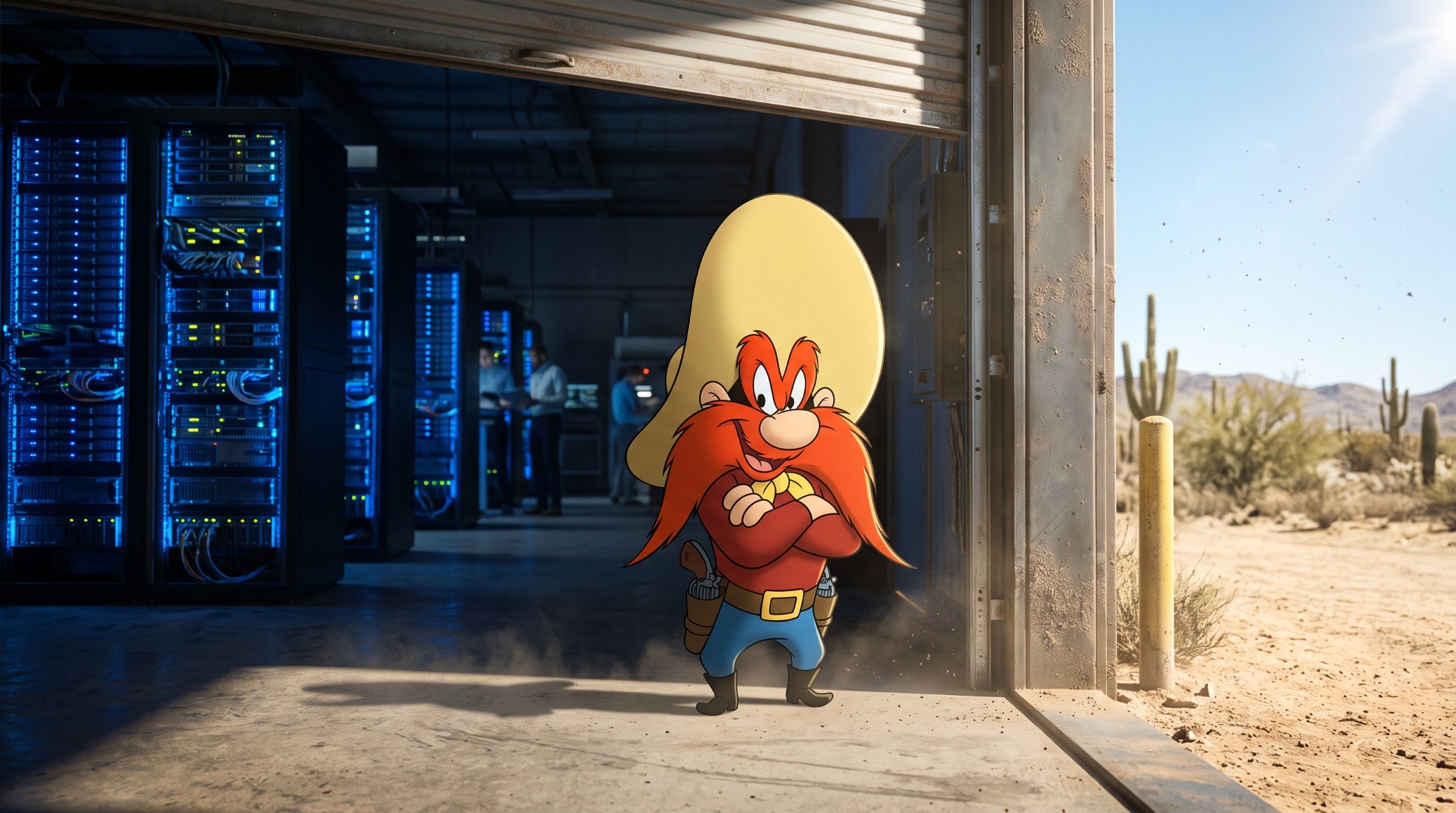
At 7:12 on a Tuesday morning, Yosemite Sam is standing in front of a former crypto mine in the desert, one boot on a coil of fiber cable, insisting that he has just opened “the fastest thinkin’ machine west of the Mississippi.” Behind him, technicians are still carrying equipment through an unfinished loading bay.
The facility is the newest data-center campus tied to Prospector AI, the Sam-backed investment company that has become the most visible piece of his latest reinvention. A ribbon is cut. Cameras fire. Sam takes three questions, answers five that were not asked, and is back in his truck before an engineer begins the actual tour.
That gap — between the thing being built and the story Sam tells about the thing being built — has become the organizing principle of one of the stranger business careers in entertainment.
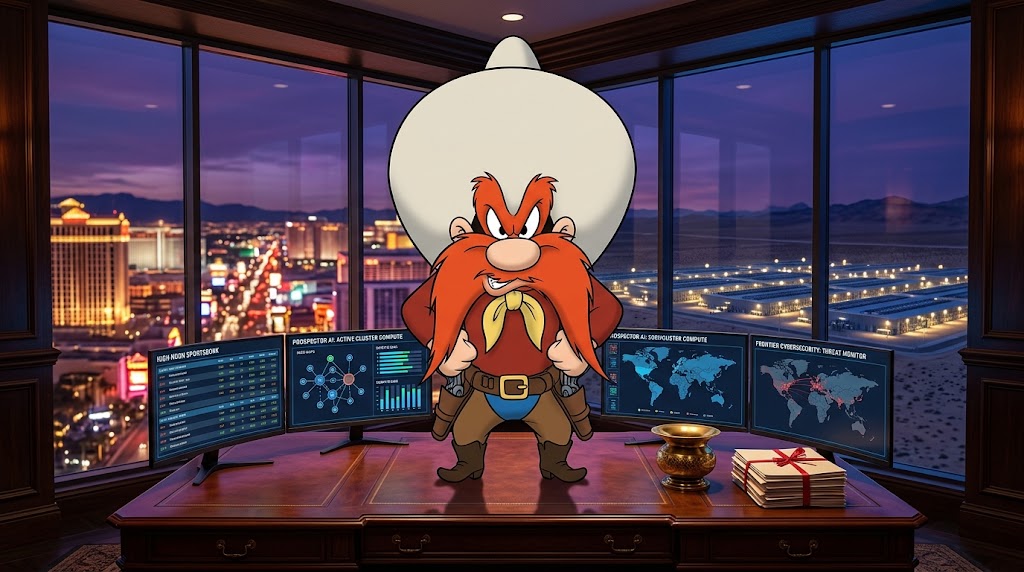
Sam’s current portfolio stretches across the original Las Vegas casino, High Noon Gaming, its online sportsbook and casino, a collection of former crypto sites now operating as data centers, Prospector AI and Frontier Cybersecurity. ACME supplies specialty hardware to several of the operations. The companies are privately held, their ownership structures overlap, and people who have worked with Sam say even insiders sometimes need a chart to remember which entity owns what.
The durable center of the empire is still gambling. Sam’s casino was the first venture that produced something his earlier schemes rarely did: predictable cash. It became a magnet for performers between bookings, event promoters and tourists willing to pay for a version of Sam’s frontier mythology with room service. Foghorn Leghorn spent a period working its tables as a croupier before returning full time to show business.
High Noon Gaming took that model online. People familiar with the business say the digital operation now reaches far more customers than the physical casino, while the property itself functions increasingly as brand headquarters, production stage and perpetual billboard.
Sam did not begin as a polished mogul. His working life has included enough short-term jobs to fill a union pension statement: sales, testing, seasonal retail and assorted hustles alongside the more famous outlaw, prospector, pirate and casino personas. In one particularly ugly chapter, he worked as a sales representative for Spargle, the energy-drink company later raided after regulators found the product contained dangerous addictive chemicals. Sam has long maintained that he was “just an innocent sales representative.”
That tension now matters more because the businesses are getting more complicated.
People who knew him before the casino describe the same appetite visible today: try everything, spend other people’s patience before spending your own money, and never let a failed venture remain onstage long enough to become the story. Early private backers from Acme Acres helped finance some of his attempts to convert notoriety into legitimate business. Most of those experiments are now footnotes. The casino was not.
Crypto came later and fit Sam almost perfectly. It had prospectors, mining, speculative fortunes and language that made every server rack sound like a covered wagon headed toward history. Sam acquired cheap land and power, filled it with mining rigs and became the public face of an operation largely designed and run by people whose names never appeared on the billboard.
When the crypto market cooled, the land and electrical infrastructure remained. Artificial-intelligence demand gave Sam a second use for both. The mines became data centers. The old mining pitch became a compute pitch. Prospector AI began taking stakes in synthetic-media and computer-vision companies that needed the infrastructure Sam already controlled.
“He is very good at standing where capital is about to look,” says one entertainment banker who has worked on financing involving Sam-linked companies. “That is a real skill. It is not the same skill as engineering the product.”
Former employees make a similar distinction. They describe Sam as an unusually effective promoter and negotiator who can get meetings that smaller operators cannot. They also describe a culture of constant renaming, accelerated launch dates and projects announced before the people responsible for delivering them have agreed on a timetable.
Three former vendors told SHOWBIZ that payment disputes are common after launches, with invoices challenged, renegotiated or delayed once the cameras are gone. A representative for Sam’s companies called that characterization “nonsense from disgruntled subcontractors” and said the group “pays valid obligations in accordance with valid contracts.”
That tension now matters more because the businesses are getting more complicated. Frontier Cybersecurity is being sold not merely as an internal service but as a stand-alone provider to studios, streaming companies and production vendors. Prospector AI is pitching synthetic-performance tools and identity systems to the same industry that is already nervous about digital replicas. Sam, meanwhile, continues to speak about both businesses as if he personally wrote the code.
Sam’s political giving has expanded with the rest of his portfolio. Federal filings list him among the biggest backers of American Frontier Action, a super PAC active in several federal races, including Foghorn Leghorn’s Senate contest. For a businessman whose interests now touch gaming, AI, data centers and cybersecurity, the donations have made politics another arena where his name is increasingly difficult to ignore.
His defenders say this criticism misunderstands the job. Sam’s value, they argue, is not that he can build a server or train a model. It is that he can attract money, attention and customers to people who can.
His critics describe the same fact less generously: Yosemite Sam has spent decades mastering the art of making the person at the microphone look like the person who built the machine.
Sam himself sees no distinction.
“Gold, cards, coins, computers,” he says. “A rush is a rush. You get there first, you stake your claim, and you holler loud enough that everybody knows whose mountain it is.”
At the desert campus, the engineers keep working after he leaves.