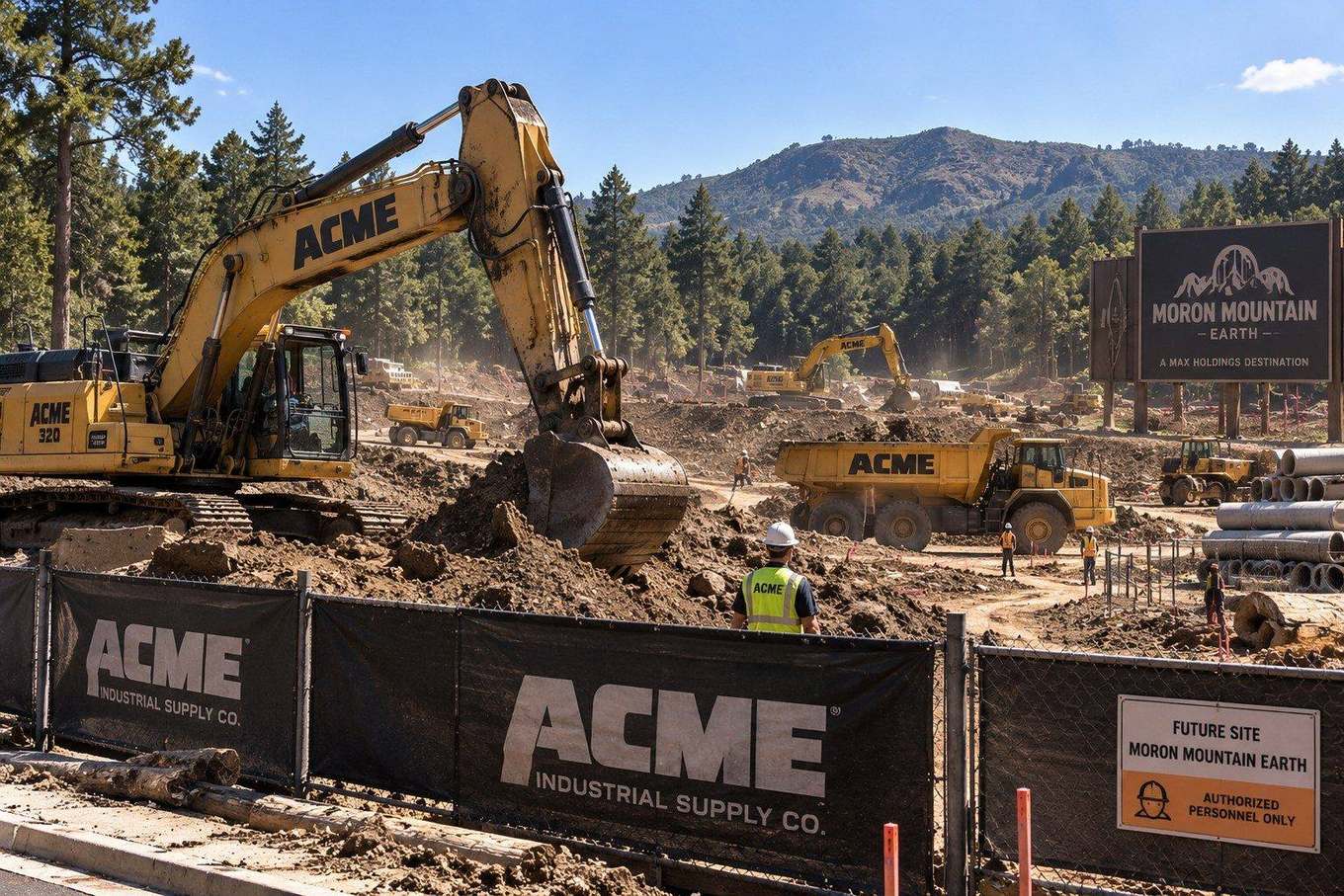
The promotional rendering is impressive.
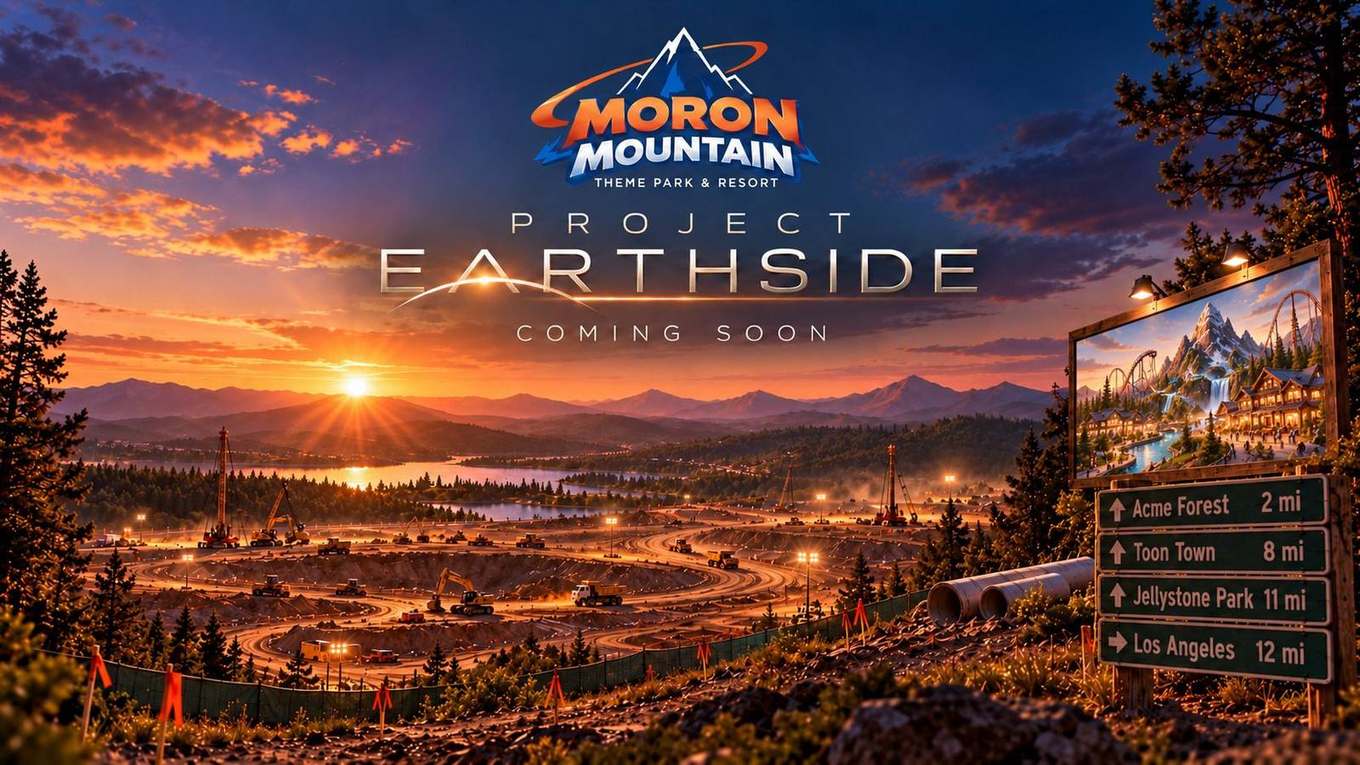
A gleaming new amusement park. Sweeping roller coasters. Elaborate architecture. Landscaped grounds. The familiar Moron Mountain logo rising above it all.
What the rendering does not show is who owns the land, who helped clear the regulatory obstacles, or who stands to profit from building the place.
Those details tell a different story.
An examination of property records, development filings and public approval proceedings by SHOWBIZ reveals that three familiar names have played significant roles in bringing Moron Mountain Earth from an ambitious proposal to an active construction site.
Yosemite Sam.
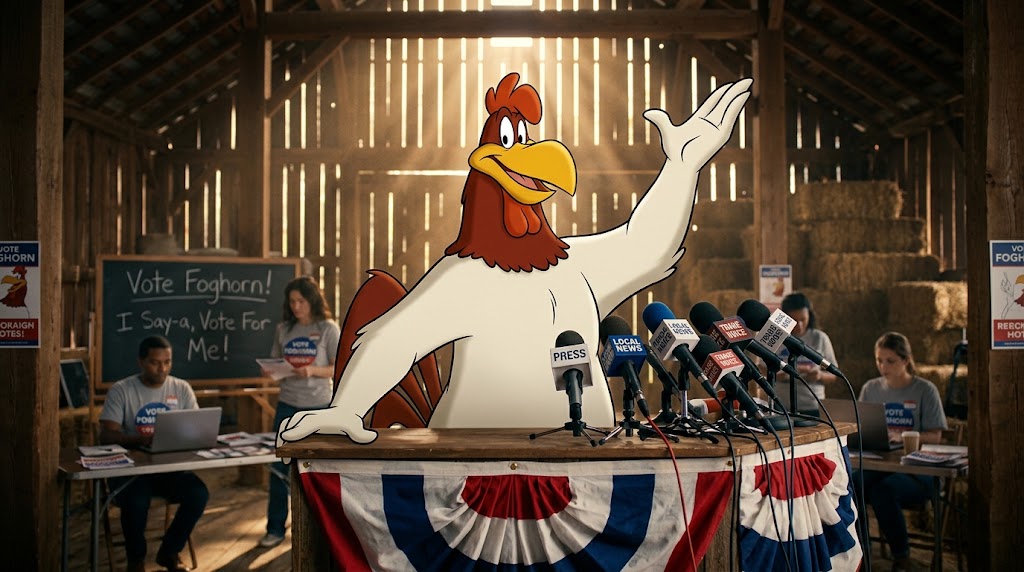
Foghorn Leghorn.
And ACME.
None is a stranger to the entertainment business. All have longstanding connections to Acme Acres and its residents.
And each occupies an important position in a development whose full financial arrangements have not been publicly disclosed.
The land
The proposed theme park occupies property claimed by Yosemite Sam between Jellystone Park and Acme Forest, a large tract near Acme Acres in the greater Los Angeles region. Most of the site is not in dispute; a strip along Jellystone’s boundary is.
Sam’s commercial interests have expanded considerably over the years, encompassing real estate, entertainment investments, gambling and technology ventures.
Among those interests is a minority stake in the modern Monstars basketball franchise.
The team’s controlling owner is Max Holdings.
That is the same company now developing Moron Mountain Earth.
And the financial relationship between Sam and Montana Max goes back considerably further than the Monstars.
Max was among the early investors who helped finance Sam’s first Las Vegas casino, Yosemite Sam’s Wooden Nickel, the venture that transformed the former gunslinger from an entrepreneurial curiosity into a legitimate businessman.
A September SHOWBIZ profile examined Sam’s casino and the private backing behind his early business ventures. The involvement of Max was not previously identified.
The investment established a business relationship that has continued in different forms for years.
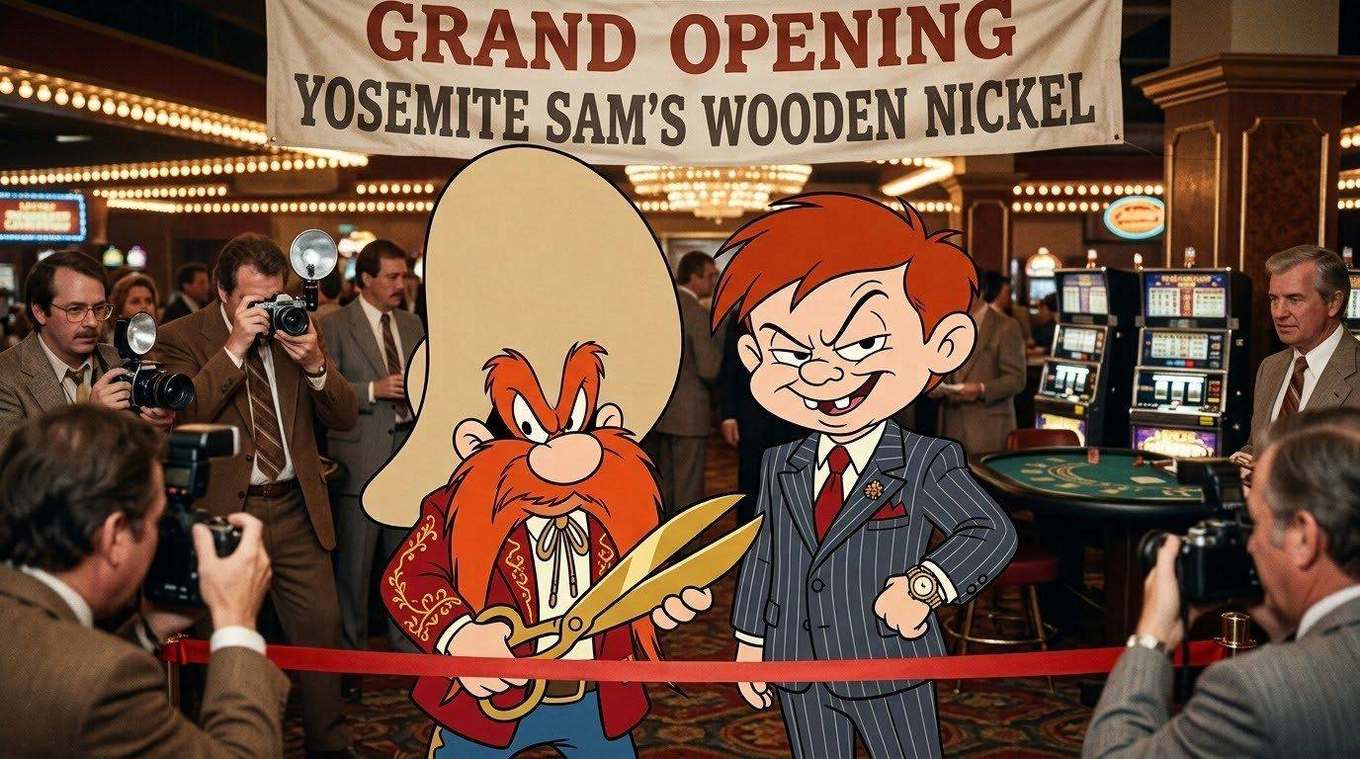
Max helped finance the casino that became the foundation of Sam’s fortune. Sam subsequently acquired a minority interest in the basketball franchise controlled by Max Holdings.
Now Sam is providing the land for Max’s newest entertainment venture.
The precise financial terms of those arrangements, including whether Max retains an interest in Sam’s casino operations, have not been publicly established.
Nor has Max Holdings disclosed whether its agreement for the Earthside property involves a purchase, a long-term lease, profit participation or another financial structure.
A representative for Sam confirmed that the property is part of the proposed development but declined to specify the terms.
“Mr. Sam is a longtime property owner and investor,” the representative said. “His existing business interests do not prevent him from entering into legitimate real estate agreements. The terms of those agreements are private.”
Sam himself was less diplomatic.
“I own the land!” he declared when contacted by SHOWBIZ. “A fella wants to build somethin’ on it, that’s business!”
He’s not necessarily wrong.
Business partners frequently invest in one another’s ventures, and longstanding commercial relationships are hardly unusual.
But those overlapping interests become more relevant when public infrastructure, government approvals and neighboring communities are involved.
They are particularly relevant in Acme Acres, where residents have already raised concerns about the loss of affordable property and the displacement of longtime neighbors.
The park next door
There is another question about Sam’s land: whether part of it was ever his to develop.
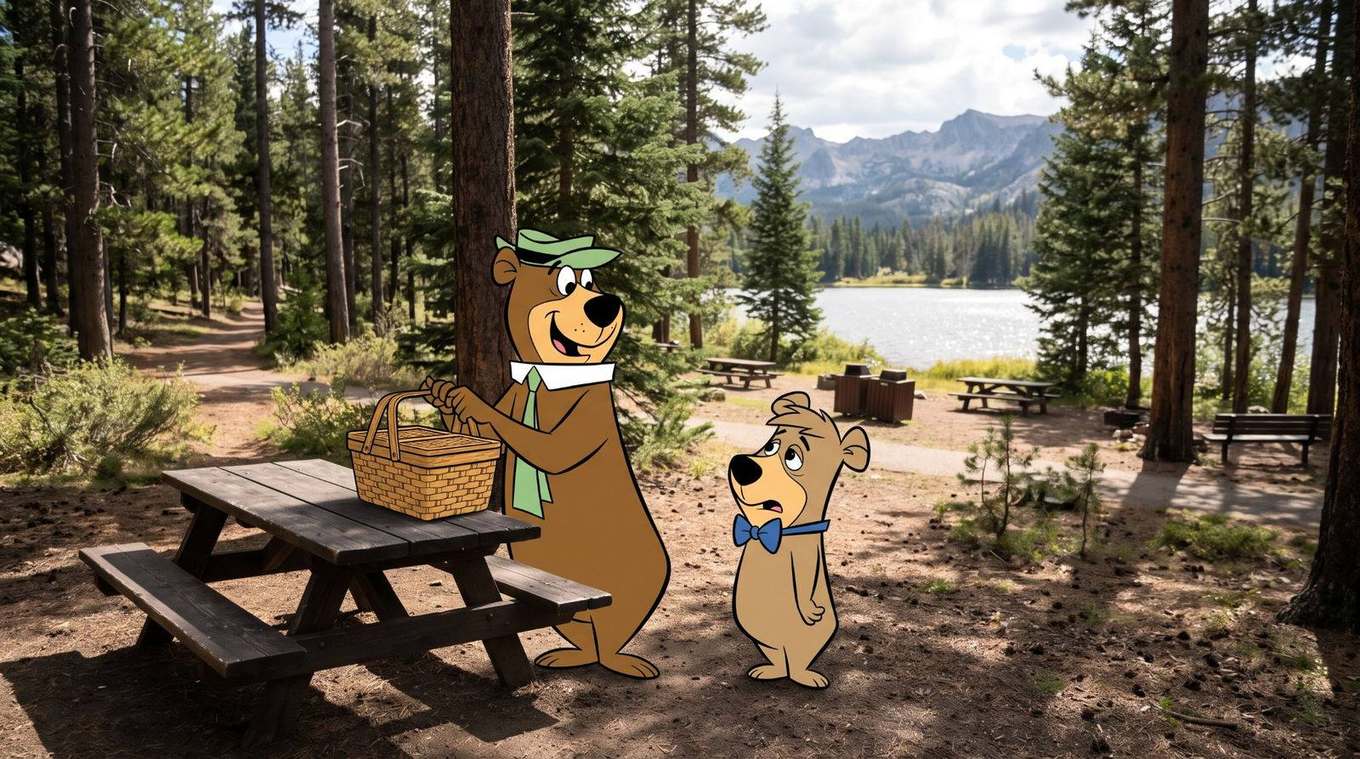
At the edge of the proposed resort is a wooded strip long treated as part of Jellystone National Park. Sixteen years ago, Jellystone faced a different commercial threat. The attempted sale of the park’s timber was stopped after Boo-Boo Bear’s discovery of a rare turtle brought attention to protected habitat there. For Yogi Bear, Ranger Smith and the park’s neighbors, the animal became an unlikely symbol of the place they had saved.
Now the turtle is missing.
Correspondence concerning a more recent wildlife review, examined by SHOWBIZ, shows that the animal could no longer be accounted for when officials revisited the park’s habitat records. No publicly released documentation establishes that it died or was relocated. Its disappearance prompted another look at the habitat map and the restrictions associated with it. It did not, by itself, make protected land available for development.
That review, however, brought older boundary surveys back into circulation. Records submitted in support of the Moron Mountain Earth project identify a strip of property long shown on Jellystone maps as overlapping a historical title claim held by Yosemite Sam. Sam’s representatives argue that the tract should be recognized as private property. Park representatives dispute the practical implications of that claim, including whether any development rights follow from it.
Those are distinct questions. A deed, even if valid, does not necessarily erase a conservation restriction or authorize construction on protected habitat. Nor does an animal’s absence establish that its habitat no longer requires protection. But an expanded, developable parcel would be valuable to Max Holdings, whose resort plans depend on the acreage Sam can make available.
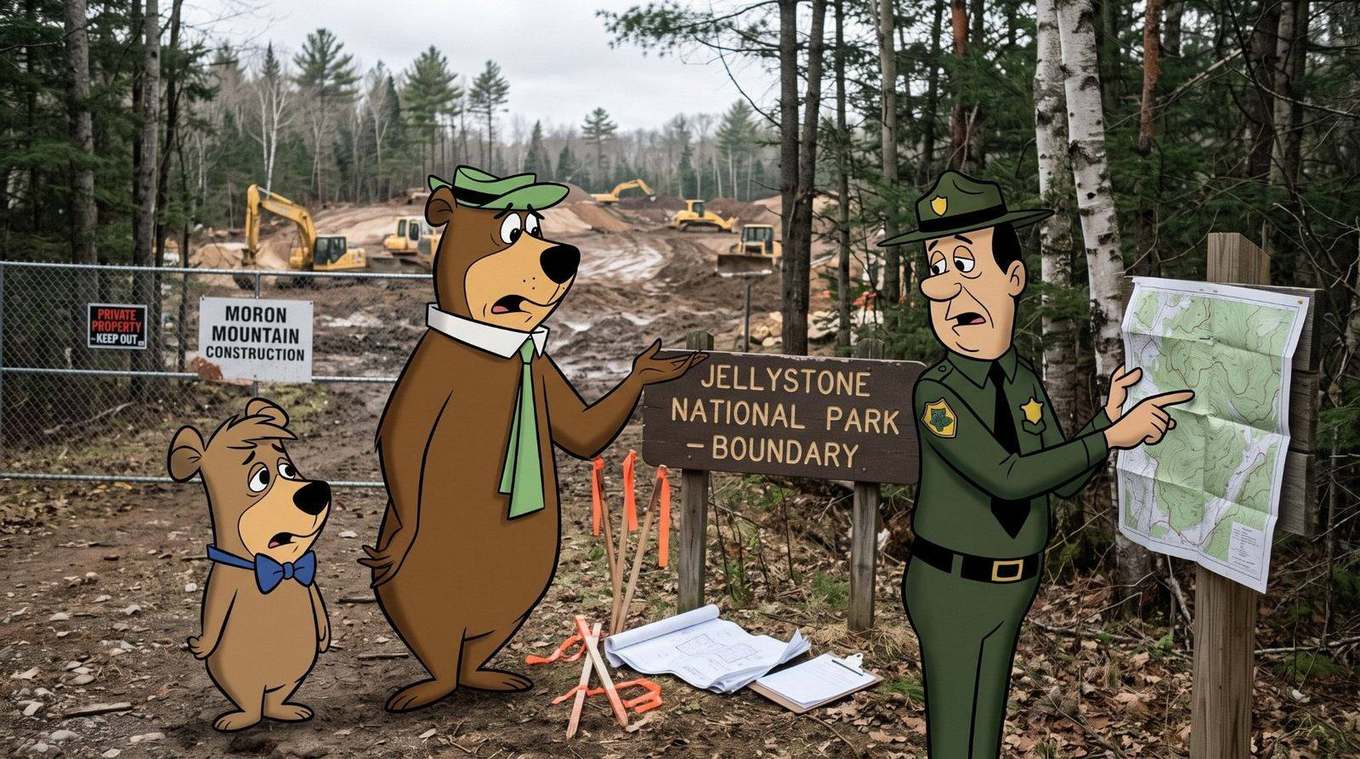
Ranger Smith, who helped protect Jellystone during the earlier dispute, said the park has sought the complete survey and an updated accounting of the turtle’s habitat. Boo-Boo, who cared for the animal when it first came to public attention, has not received a definitive explanation of what happened to it. Yogi has questioned the timing of the review but has not presented evidence that the developer removed the turtle.
The push to settle the land question has also drawn attention to Foghorn Leghorn. Communications examined by SHOWBIZ show that Leghorn urged officials to address the boundary review alongside other accelerated approvals for Moron Mountain Earth. His advocacy does not determine who owns the land; it does raise questions about why a disputed claim affecting a national park has moved so quickly toward a development decision.
Max Holdings denies involvement in the turtle’s disappearance and maintains that the project is proceeding on property lawfully made available by Sam, subject to required reviews. Sam’s representatives stand by the company’s title claim. Neither response resolves the animal’s whereabouts or the extent of the protections still attached to the contested strip.
Yogi has said he and Bugs Bunny privately discussed their opposition to the project before Bunny’s death. Whether Bugs knew anything about the turtle or the newly disputed surveys is unknown.
Jellystone was saved once because a turtle was found. What its disappearance has meant for the park’s boundaries—and for the amusement park rising next door—is now part of the story of who gets to build on this land.
And the connections do not end at the property line.
The approvals
Building an amusement park is not the same as building a shopping center.
Large entertainment destinations typically require extensive reviews involving land use, transportation, water, infrastructure, environmental protections and public safety.
Projects near environmentally sensitive areas can face additional scrutiny. Moron Mountain Earth’s site, between Jellystone Park and Acme Forest, makes those questions particularly relevant.
Moron Mountain Earth has moved through the early stages of that process with unusual speed.
Development records reviewed by SHOWBIZ show that several preliminary reviews were placed on accelerated schedules, allowing certain planning and site-preparation decisions to proceed concurrently rather than sequentially.
The result has been a substantially compressed approval timetable.
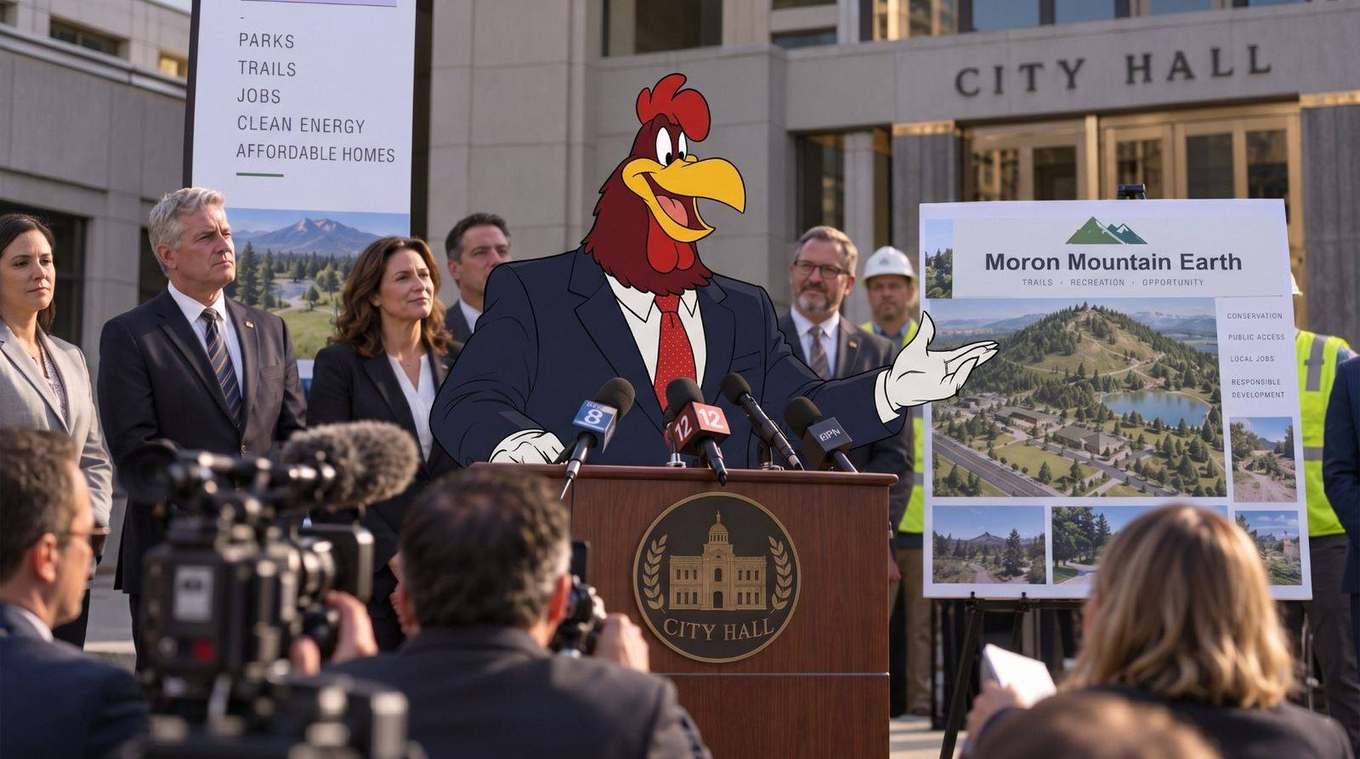
A prominent advocate of that approach has been Foghorn Leghorn.
The former Enormocorp executive, now seeking election to the United States Senate, has publicly championed the development as an economic opportunity for the region.
Leghorn’s involvement also comes with a complicated history.
Before entering politics, he served as chief executive of ACME, the industrial supplier now positioned to receive one of Moron Mountain Earth’s largest commercial contracts.
It was during Leghorn’s tenure that Wile E. Coyote’s product-liability litigation brought allegations about ACME’s equipment and business practices into public view.
The resulting legal battles have left the company facing severe financial pressure.
The proposed Earthside contract could provide a substantial new source of revenue.
Leghorn also has an older connection to Yosemite Sam. Before his corporate career, he spent a period working as a croupier at Sam’s Las Vegas casino.
That employment is not itself unusual. But there is a more consequential financial relationship between the two men.
Sam is a major contributor to American Frontier Action, the independent super PAC supporting Leghorn’s Senate campaign.
The organization operates independently of Leghorn’s campaign, and contributions to a super PAC are not equivalent to direct campaign donations.
But the political spending adds another layer to an already complicated set of business relationships.
A major supporter of the organization backing Leghorn stands to benefit from the development of his land.
A financially troubled company once led by Leghorn stands to receive a potentially enormous contract.
And Leghorn has been advocating for accelerated government review of the project that connects them.
Leghorn has participated in discussions with government officials and urged agencies to coordinate their reviews of the project.
One communication reviewed by SHOWBIZ argues that Moron Mountain Earth should receive priority consideration because of its projected employment and tourism benefits.
Asked whether Sam’s financial support or Leghorn’s previous role at ACME presented a conflict of interest, the campaign rejected the suggestion.
“American Frontier Action is an independent organization,” a campaign spokesperson said. “Mr. Leghorn has no role in selecting Moron Mountain Earth’s suppliers, and his support for the project is based on its potential to create jobs and investment. He has advocated for coordination between agencies, not exemptions from the law.”
The campaign did not provide a complete record of Leghorn’s communications with the agencies involved.
Asked directly about his involvement, Leghorn was characteristically emphatic.
“I say, I say, there’s a difference between moving a project forward and standing in its way,” he told SHOWBIZ.
There is no evidence that Sam’s political contributions purchased preferential treatment or that Leghorn improperly directed the award of ACME’s contract.
That distinction matters.
Leghorn does not personally issue building permits, and political advocacy on behalf of a development is not inherently improper.
Officials retain responsibility for deciding whether statutory requirements have been met.
But public encouragement, institutional relationships and access to decision-makers can influence how quickly a development advances through the process.
And when a project receives expedited treatment, the question is not simply whether approvals were granted.
It is whether the underlying scrutiny remained the same.
Several important reviews, including those governing the future operation of the attractions themselves, remain pending.
The permits already granted principally concern preliminary development and site preparation.
Nevertheless, construction equipment is on the property, grading is underway and the developer has moved considerably closer to its stated objective.
For an industry accustomed to delays, that is no small accomplishment.
For residents concerned about the surrounding forest, it warrants explanation.
The anvil
Then there is ACME.
The company whose name has appeared on an extraordinary assortment of rockets, explosives, mechanical contraptions, industrial machinery and occasionally unsuccessful consumer products is set to play a central role in constructing Moron Mountain Earth.
According to development materials, ACME will supply the project’s principal construction and attraction hardware, including mechanical systems, structural components, specialized equipment and technology intended for the resort’s eventual operation.
It is a potentially enormous commercial commitment.
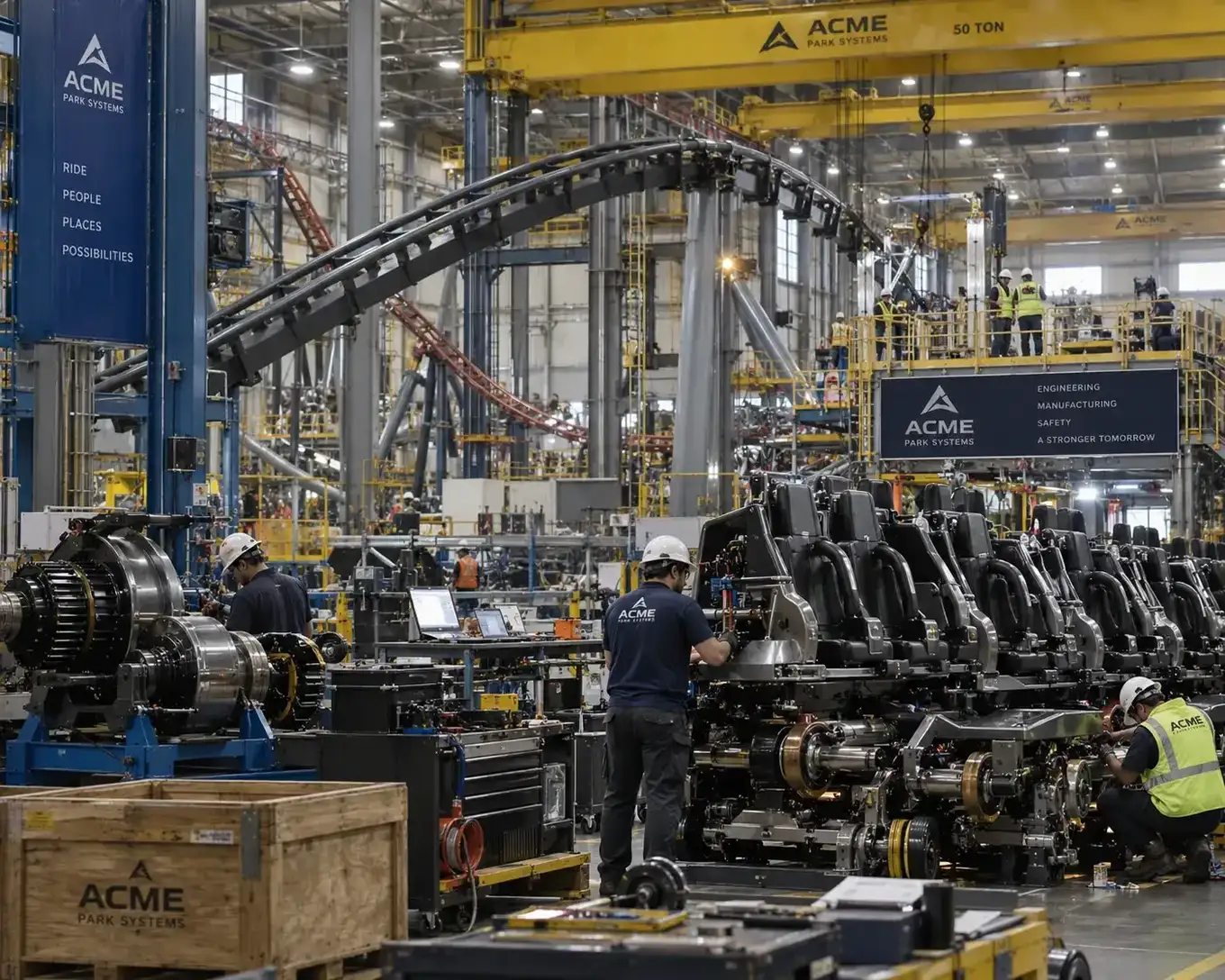
For ACME, the contract could hardly arrive at a more consequential moment.
The company has been battered by litigation stemming from allegations of defective products, including claims that came to public attention during Foghorn Leghorn’s tenure as chief executive.
Legal expenses and mounting liabilities have placed ACME under severe financial strain.
The resort contract could provide a badly needed source of revenue.
Financial terms have not been released.
Neither has a detailed explanation of the supplier-selection process.
ACME’s involvement is not surprising on its face.
The company has supplied hardware to the Toon entertainment industry for generations.
Its equipment is familiar to practically every resident of Acme Acres, including some who have encountered it while traveling at considerable speed in the wrong direction.
Familiarity, however, is not the same as reassurance.
Amusement park attractions must operate repeatedly, carry paying guests and meet safety standards that cannot be satisfied by the traditional Toon understanding that most injuries are temporary.
A spokesperson for Max Holdings said all attractions will undergo the required engineering reviews and independent safety inspections before opening.
“ACME is a longstanding leader in specialized entertainment hardware,” the spokesperson said. “Every system installed at Moron Mountain Earth will be subject to the applicable testing and certification requirements.”
That statement is important.
So is the need for independent inspection.
An exclusive or near-exclusive hardware arrangement places considerable responsibility in the hands of one supplier.
And although ACME has expertise in almost every category of equipment imaginable, its products also possess a well-documented tendency to behave in ways their purchasers did not anticipate.
For a company whose customer base includes Wile E. Coyote, that may be considered a competitive advantage.
For a roller coaster operator, it is a more complicated selling point.
The connections
Consider the project as a whole.
The developer helped finance the landowner’s first major business success.
The landowner holds a stake in the developer’s basketball franchise and financially supports an independent political organization backing the Senate candidate who has advocated for the project.
That candidate previously ran ACME, a company now struggling under the weight of litigation and positioned to receive a potentially enormous hardware contract from the development.
None of these relationships, individually or collectively, establishes misconduct.
But together, they demonstrate that Moron Mountain Earth is not simply a transaction between unrelated businesses.
It is the latest venture involving a network of people whose financial and professional interests have intersected for years.
And that makes transparency about the property’s ownership, regulatory approvals and supplier contracts especially important.
Max Holdings has presented its expansion as a new chapter for a company eager to move beyond the legacy of its original owner, Mr. Swackhammer.
There is reason to believe that transformation is real.
The modern Moron Mountain is a functioning resort, the Monstars operate as a professional sports franchise, and the proposed Earth development promises jobs and substantial investment.
The company also argues that the expansion offers something the original resort could not: accessibility.
“For years, visiting Moron Mountain meant paying for interplanetary transportation before you even reached the front gate,” a Max Holdings spokesperson told SHOWBIZ. “That’s simply beyond the means of many families. Bringing Moron Mountain to Earth gives those people an opportunity to experience something they otherwise might never have been able to enjoy.”
The argument is not without merit.
The resort’s original location, on a distant planet within the Martian Empire, has traditionally made it an expensive destination for Earth-based visitors.
Moron Mountain Earth would eliminate that particular obstacle.
Admission prices have not been announced, however, and the company has not explained whether any measures will ensure the new destination remains affordable to the communities surrounding it.
That distinction is particularly relevant in Acme Acres, where longtime residents have already been confronting the prospect of being priced out of their own neighborhood.
And the company’s history is part of the reason this particular project deserves scrutiny.
In 1996, the original Moron Mountain business plan involved taking entertainers from their homes and forcing them to perform for customers.
Bugs Bunny and his fellow Looney Tunes prevented it.
Thirty years later, a company descended from that operation is preparing to open a permanent facility near Acme Acres.
The circumstances are different.
The ownership is different.
The stated business model is different.
Those distinctions matter.
Bunny, who died September 29, was a familiar presence in a community that has spent the past several days reflecting on the people and principles that shaped it.
Porky Pig, Bunny’s longtime friend and colleague, was reluctant to speculate about how the late entertainer would have responded to the development.
“I-I can’t tell you exactly what Bugs would’ve thought,” Porky said. “But he never liked anybody telling people where they belonged. I think he’d have wanted the neighbors to have a say.”
It is a simple sentiment, but one that resonates in a community already struggling with the consequences of development.
The new relationship with Moron Mountain is being negotiated not through a basketball game but through property agreements, regulatory filings and supply contracts.
That may be progress.
It may also be an unusually expensive reminder that entertainment has always been a business.
What remains unanswered
Max Holdings has not publicly disclosed the complete financial terms of its arrangement with Yosemite Sam.
An investor briefing reviewed by SHOWBIZ also identifies Perkins Strategic Advisory among the outside firms consulted on market forecasts and projected visitor demand. The documents do not establish that the consultancy played any role in obtaining government approvals.
The full scope of Foghorn Leghorn’s involvement in securing expedited review has not been independently established.
And ACME’s contract, including its precise value and selection criteria, remains largely confidential.
Each of those facts leaves legitimate questions for the developer and public authorities to answer as construction continues.
So do the missing Jellystone turtle, the newly contested boundary survey and the environmental protections that may still cover the disputed land.
For residents of Acme Acres, those questions extend beyond the financial arrangements.
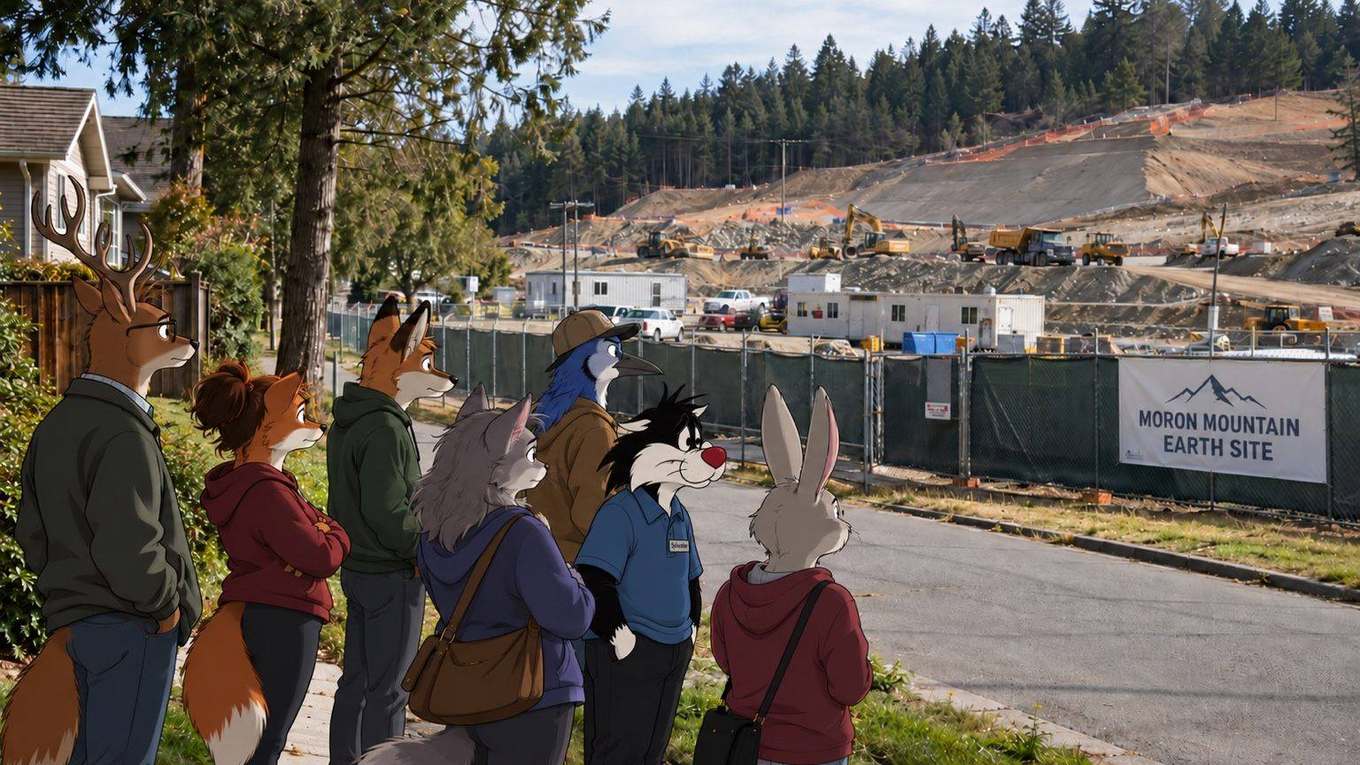
What protections will prevent surrounding properties from being swallowed by further development? How will increased traffic affect nearby communities? And how much opportunity will residents have to shape a project that could permanently alter the place they call home?
In the meantime, a billboard overlooking the cleared property offers visitors an artist’s rendering of what Moron Mountain Earth will eventually become.
Behind it, earthmovers cross freshly graded soil. Equipment waits beside temporary access roads. Workers prepare a site where no rides have yet been built.
Above the scene is a familiar slogan:
COMING SOON.
The park may be years away.
The business arrangements that made it possible are already here.
And for once, the most interesting thing about an ACME project may not be what happens when somebody pulls the lever.