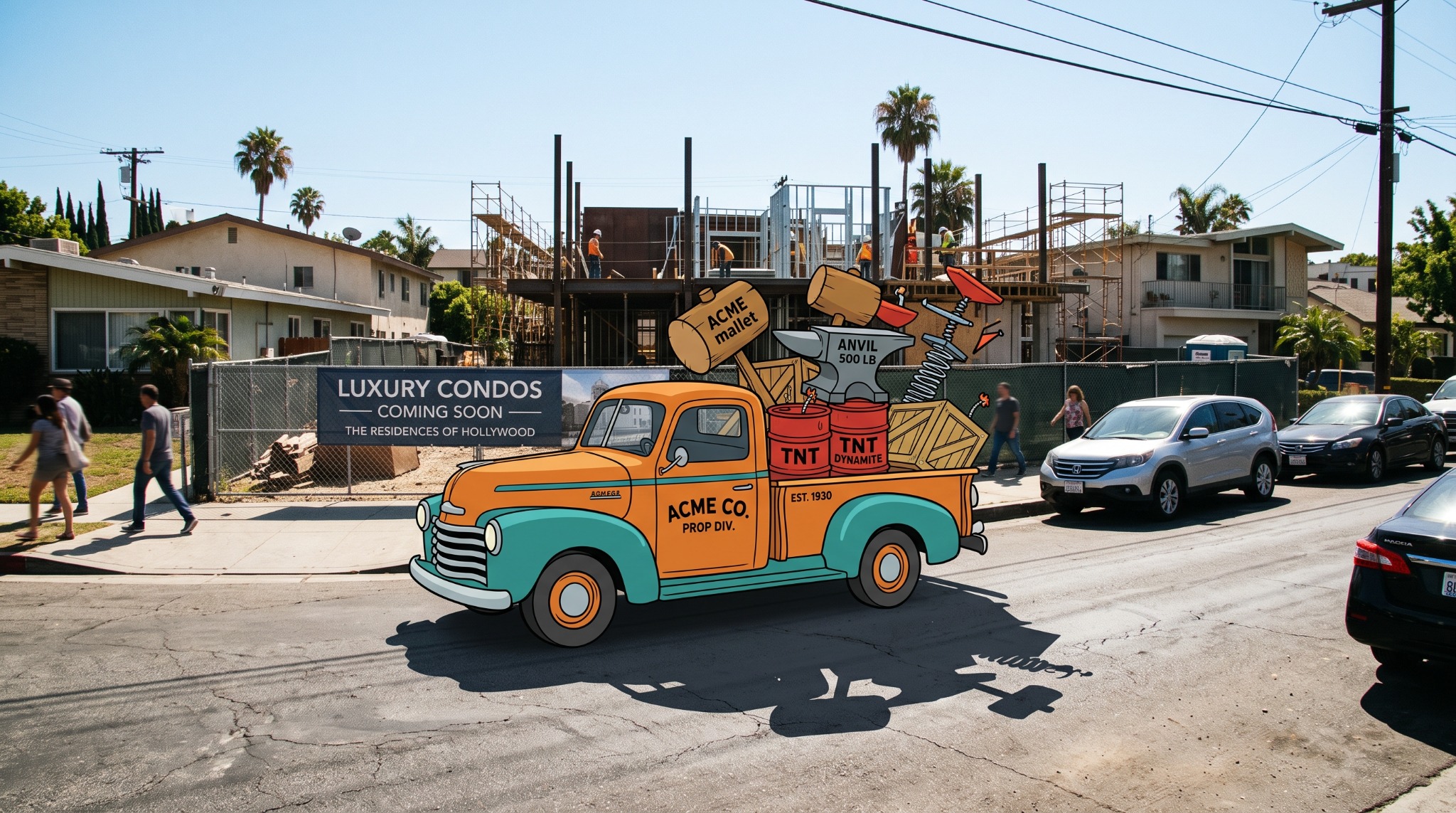
For decades, Acme Acres was where animation workers moved when they could no longer justify ToonTown prices but still needed to be close enough to make a 6 a.m. call.
The town’s advantages were never glamorous: cheaper apartments, modest houses, a commercial strip built around the Acme Mall and smaller neighborhood shops, and a large student population anchored by Acme Looniversity. The school has long functioned as the town’s industry pipeline, training younger performers under veteran Looney Tunes mentors; nearby Perfecto Prep gives the same corridor a second, much wealthier student market. Acme Acres housing also evolved around residents who do not always fit conventional building codes — burrows, reinforced floors, oversized doors and the occasional unit designed to survive an indoor piano drop.
That combination has suddenly made Acme Acres valuable.
As rents around the major studio districts have climbed, background performers, cleanup artists, prop builders, voice actors, stunt specialists and junior production staff have been moving outward. Leasing agents say the heaviest demand is now within a short commute of the Looniversity corridor, where older apartments once marketed primarily to students are being renovated and repriced for full-time industry workers.
A SHOWBIZ review of current listings found asking rents in several central Acme Acres blocks running sharply above their pre-boom levels, with the steepest increases in units large enough to accommodate families or production equipment. Smaller apartments remain cheaper than comparable ToonTown stock, but the gap is narrowing.
“The pitch used to be: live here while you figure out your career,” says one local property manager. “Now the pitch is: live here because you can’t afford to live where your career is.”
“Now the pitch is: live here because you can’t afford to live where your career is.”
Developers have noticed. Low-rise apartment projects are moving through planning near the commercial corridor, older single-family properties are being converted to rentals, and investors are assembling parcels near transit routes used by studio commuters. Several new projects advertise toon-adaptable construction as a premium feature rather than an oddity.
The boom is welcome to some local officials, who argue that Acme Acres needs more housing at every price point. It is less welcome to tenants who were already stretching to stay.
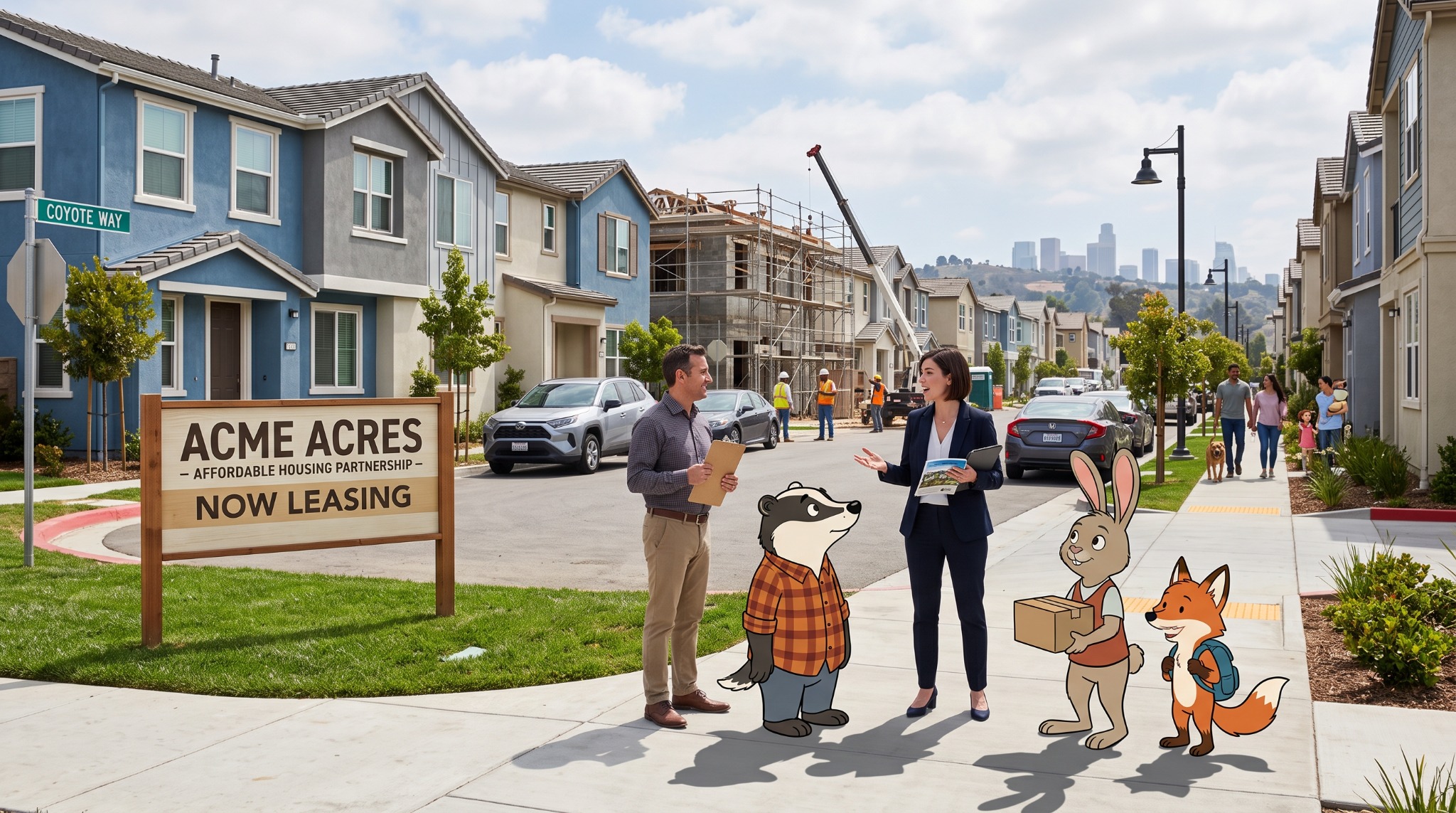
The Acme Acres Tenants Guild says it has seen a rise in informal evictions, aggressive renovation notices and lease non-renewals in buildings that changed hands during the past two years. Faculty and staff at Acme Looniversity have separately pushed the school to develop below-market housing, warning that instructors increasingly commute from outside town.
“We’re becoming the affordable alternative to a place that became unaffordable,” says a guild organizer. “That works for about five minutes. Then the alternative becomes the next expensive place.”
The geography makes the problem unusually complicated. Acme Forest limits expansion in one direction. Looniversity occupies a large central footprint. Older neighborhoods contain a patchwork of conventional lots and toon-specific parcels that are difficult to finance or redevelop. Commercial land near the Acme Mall and the old Buy N’ Buy corridor is therefore carrying much of the pressure.
Builders want taller projects and faster approvals. Tenant groups want rent protections and replacement requirements when older units are removed. The city is considering design standards for new buildings that would account for residents who may be unusually small, unusually tall, temporarily flattened or capable of entering through a painted tunnel.
The jokes do not change the economics. Working animation performers have always had volatile incomes, and the streaming era has made residuals less predictable for many of them. Production employment remains cyclical. A tenant who can comfortably qualify for an apartment during a series order may look very different to a landlord six months after cancellation.
That is why housing has quietly become an industry issue rather than merely a local one. If assistants, craftspeople, junior artists and working performers have to move farther from the places that hire them, production absorbs the cost in longer commutes, thinner labor pools and more people deciding the career is no longer worth the geography.
Acme Acres is not yet ToonTown. That is precisely why people keep moving there.
The question is how long it can remain the alternative once everybody knows about it.