
Bosko has been famous twice and forgotten twice.
On Thursday evenings, he takes an aisle seat in the small screening room at the Toon Motion Picture Home & Hospital, where residents gather to watch movies that most of them remember making better than the audience remembers seeing.
Tonight, a black-and-white short is already flickering across the screen when Bosko walks in.
Honey appears.
She is young there. Everybody is young there.
A few residents laugh at a gag Bosko has watched hundreds of times. Another mouths dialogue half a second before the soundtrack reaches it. A former background player sleeps beneath a blanket in the back row.
Bosko watches Honey.
“She always knew where the laugh was,” he says afterward.
Honey died years ago.
The film did not.
That distinction — between the performer and the performance, between the character Hollywood remembers and the person who must keep living after Hollywood moves on — is becoming one of the animation industry’s oldest unsolved problems.
For generations, the mythology was easier.
Toons did not die.
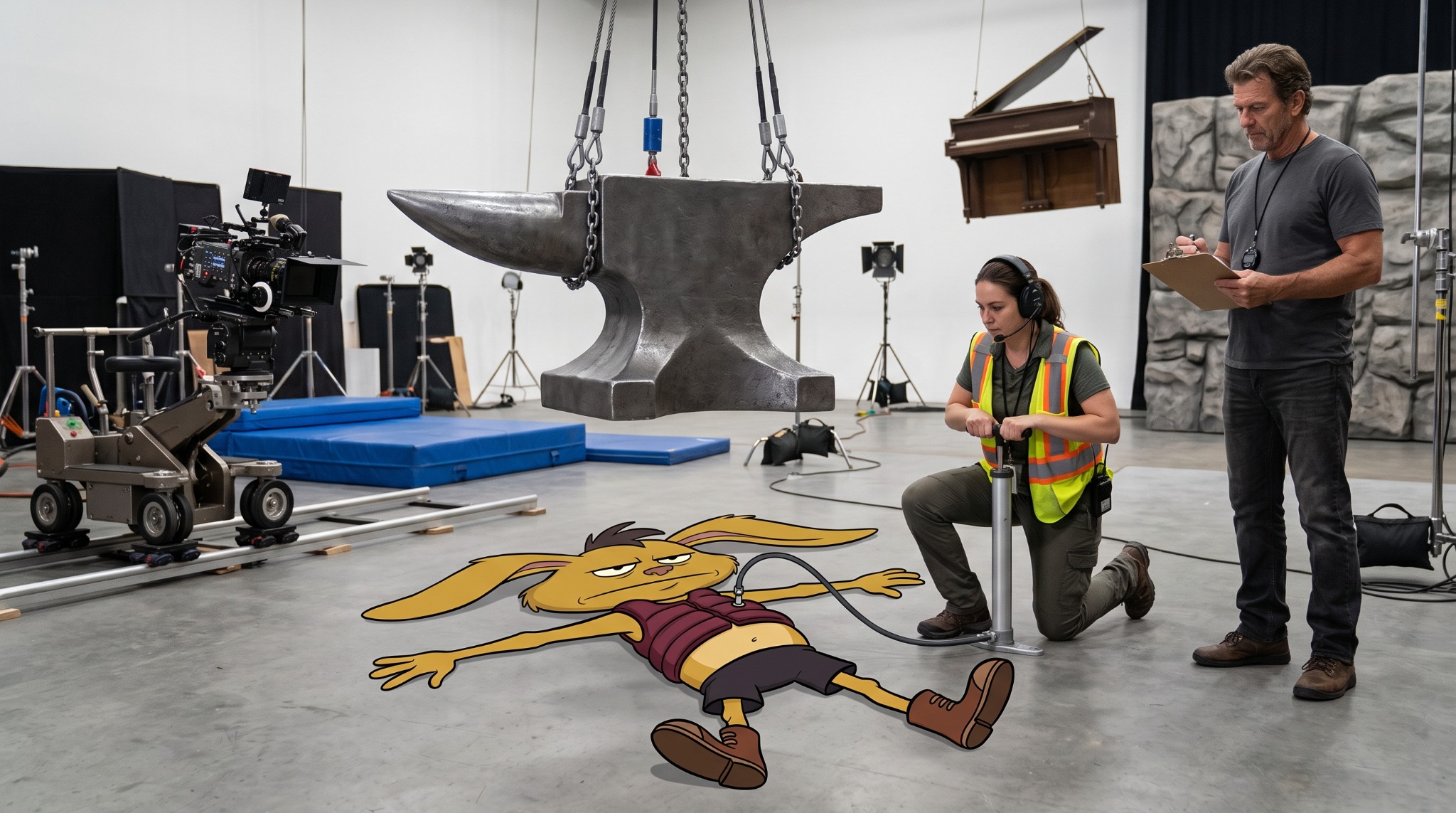
They were flattened, detonated, shot, incinerated, dropped from cliffs, folded into accordions and struck by falling pianos. Seconds later, they stood up.
Sometimes they were missing a few teeth.
Then the picture ended.
Real life continued.
WHEN THE CAMERA STOPS
There is no standard second act for a former cartoon star.
Some retire comfortably. Some discover that obscurity suits them.
Chip, once half of television’s Rescue Rangers, spent years living quietly in the suburbs and selling insurance after his series ended. Dale chose almost the opposite path: convention appearances, nostalgia bookings and a much-publicized CGI surgical conversion intended in part to modernize his appearance for contemporary work.
Neither path resembles the fame they once knew.
Neither is a tragedy.

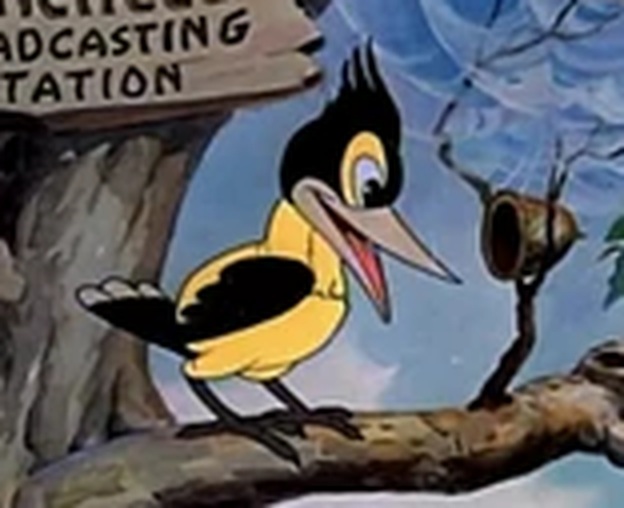
Buddy, who succeeded Bosko as one of Warner Bros.’ earliest Looney Tunes headliners, took another route. After a brief career at the center of the studio’s cartoon output, he largely disappeared from entertainment and eventually settled into agricultural work in Ojai.
He has mostly avoided the press.
His old movies have not.
For other performers, the record is less comforting.
Pooch the Pup headlined his own Walter Lantz series in the early 1930s. His theatrical career ended almost as suddenly as it began. Industry archivists can reconstruct the films more easily than they can reconstruct the life that followed them.
That is not unusual.
Early studio employment records were incomplete. Toon performers moved between companies, changed names, worked without residual protections or simply disappeared from professional life.
Some went home.
Some took regular jobs.
Some lived on royalties.
Some did not own enough of themselves to receive any.
And welfare organizations say there are former performers whose current whereabouts remain unknown.
Miss Bianca, the veteran Rescue Aid Society delegate who now advises the Home’s missing-performer outreach program, is careful about the word missing.
“Sometimes someone wants privacy,” she says. “Sometimes we have returned mail for twenty years.”
Sometimes it means something worse.
Outreach teams have found aging performers living in motels, vehicles and temporary housing. Others first come to the Home’s attention after a medical emergency reveals that a character whose face remains recognizable around the world has almost no personal savings.
The irony is uniquely Toon.
A performer can disappear while the character becomes more valuable.
THE BUSINESS OF BEING REMEMBERED
Animation has always blurred the boundary between worker and intellectual property.
For a human actor, a studio may own a film.
For a Toon, the studio may also own the name, design, wardrobe, catchphrase and licensed image through which the performer is recognizable to the public.
Retirement does not necessarily end that relationship.
A long-retired Toon may walk through a grocery store and see his own face on a cereal box without having approved the campaign. A performer can watch a studio remaster old footage, revive a franchise or sell new merchandise while receiving little or none of the resulting revenue.
Increasingly, there is another possibility:
The production may no longer require the performer at all.
Digital replicas and artificial-performance technology have opened the possibility of new work featuring characters whose original performers are elderly, unavailable or dead.
For some aging Toons, that anxiety has helped fuel another industry.
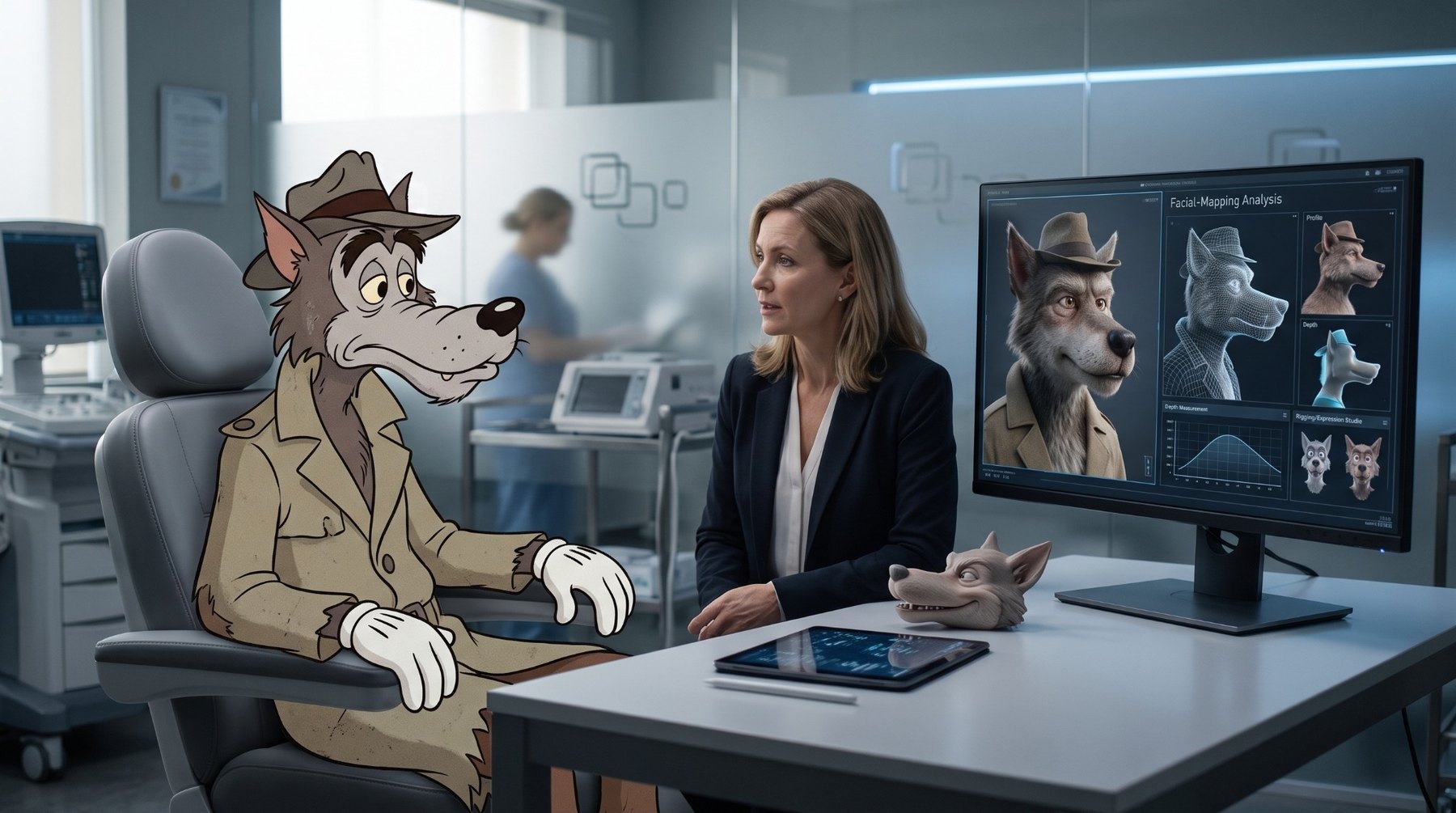
CGI surgery — once treated as an eccentric experiment — is now advertised as a way for traditionally rendered performers to compete for contemporary productions. Clinics promise easier compositing, greater compatibility with modern pipelines and, sometimes explicitly, a younger-looking career.
Dale became its most famous success story.
But at the Motion Picture Home, residents are skeptical of the promise that a new rendering style can solve an old labor problem.
“You can change the pixels,” one retired performer says. “You can’t make them call.”
For the residents here, the more immediate question is what happens when they stop calling altogether.
BOSKO BEFORE BUGS
Bosko does not need anyone to explain what it feels like to watch the industry continue without you.
He was there near the beginning.
Before Porky Pig. Before Daffy Duck. Before Bugs Bunny became the studio’s most enduring star, Bosko was one of the central faces of Warner Bros. animation.
His early work is also inseparable from a more difficult history. Like much American animation of its era, Bosko’s original screen identity drew from racist minstrel traditions that modern studios and historians have had to confront rather than sanitize.
Bosko does not object to that reckoning.
“You should know what was wrong,” he says. “You should know where things came from.”
But historical discomfort and historical disappearance are not the same thing.
After Bosko left Warner Bros., newer stars arrived. Distribution patterns changed. Black-and-white shorts became harder to sell. Generations grew up knowing characters whose careers began after his.
Bosko became the answer to a trivia question about who came first.
“I was the first,” he says. “That doesn’t mean I was the one they remembered.”
Then he met a rabbit who did.
FIELDS OF HONEY
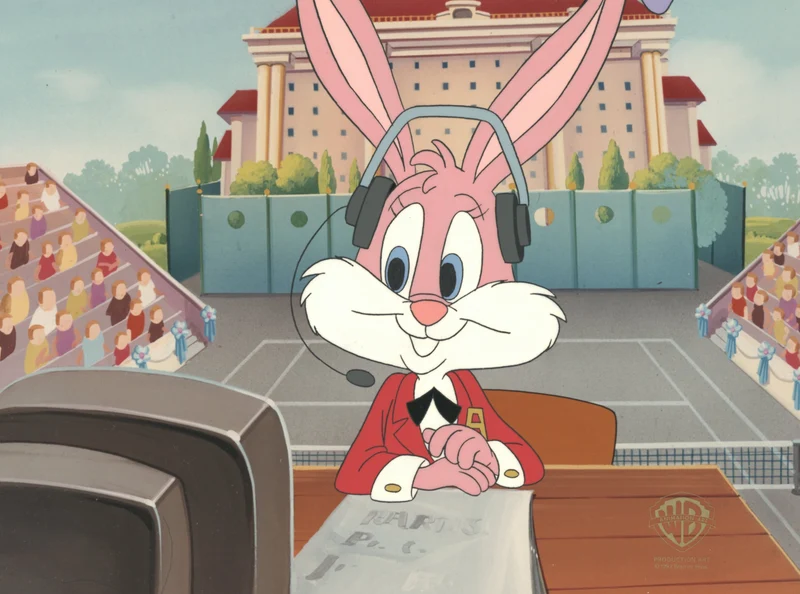
Babs Bunny was looking for a female Toon role model when she found Honey.
By then, Honey had been absent from public life for decades.
Babs dug through the Warner archives, resurrected old films and eventually built a theater around Honey’s work.
The audience laughed.
And, in one of those episodes of Toon physiology that physicians still struggle to explain scientifically, the laughter seemed to restore something that years of obscurity had taken away.
Honey reemerged.
So did Bosko.
They found one another again and, later in life, married.

“People tell that story like the ending is that everybody remembered them,” Babs says. “That wasn’t the ending. That was the beginning of the time they finally got back.”
Their life afterward was quieter than the rediscovery suggested.
Honey saved matchbooks from theaters that screened her old films. On the back of photographs, she wrote names and dates in pencil because, Bosko remembers her saying, “somebody ought to know who was there.”
At home, she still corrected Bosko when he told stories out of order.
“She’d say, ‘That didn’t happen in ’31. You wore the other hat in ’31,’” he recalls.
There were screenings. Retrospectives. Invitations. Younger animators wanted photographs.
Then Honey was diagnosed with cancer.
WHAT AN ANVIL CAN’T FIX
The central misconception of Toon medicine is also its most persistent:
Extraordinary resistance to physical trauma is not immortality.
Dr. Kureha has practiced medicine long enough to watch whole generations grow old around her. The Sakura Kingdom physician, known for an abrasive bedside manner and an almost unnerving longevity of her own, has increasingly consulted with physicians treating aging animated patients.
She has little patience for Toon exceptionalism.
“People confuse surviving with being healthy,” she says. “They’re not the same thing.”
A Toon body may recover spectacularly from physical deformation and still develop cancer, degenerative illness, infection or organ failure.
Then Kureha puts the distinction more simply:
“Being able to survive an anvil isn’t the same thing as being unable to die.”
At the Home, Dr. Madge Honey Badger sees families struggle with that idea almost every week.
Honey Badger, who previously worked on complex unexplained illnesses in Zootopia, now directs the Home’s Toon Medicine Program.

A human family generally understands that cancer may be fatal.
A Toon family has sometimes watched the same relative survive explosions for eighty years.
“We have patients who waited because they assumed something would reset,” Honey Badger says. “Disease doesn’t care how many times you’ve survived a piano.”
The medicine itself can look surprisingly ordinary.
Hospice patients receive treatment for pain, anxiety, nausea, breathlessness and other symptoms. Opioids, including morphine, remain a standard part of end-of-life symptom management. When swallowing becomes difficult, comfort medications may be available in concentrated liquid forms or by other medically supervised routes.
Doctors repeatedly emphasize the distinction between treatment and intent.
Hospice medicine is intended to relieve suffering.
It is not intended to cause death.
For Toons, however, another category of medicine exists.
Its history is much darker.
THE WORD NOBODY WANTED TO SAY
Older Toons still call it Dip.
Doctors generally do not.
The regulated medical-aid-in-dying treatment developed from decades of research into Toon-dissolving compounds is formally known as Controlled Dissolution Therapy — CDT.
The language is deliberate.
Historical Dip was a weapon: an uncontrolled industrial solvent mixture capable of permanently destroying a Toon.
CDT is medicine.
It is standardized, medically manufactured and available only under tightly controlled medical-aid-in-dying frameworks in jurisdictions where the practice is legal. It is not kept on ordinary hospice carts. It is not used for routine pain control. Its authorization and handling are separate from palliative medication.
Dr. Honey Badger says the distinction matters medically.
Dr. Kureha says that does not mean it feels different emotionally.
“You can rename something,” Kureha says. “You cannot rename what people remember.”
For older Toons, the word Dip remains attached to fear, violence and a time when their ability to be permanently killed was itself a weapon against them.
Modern medicine has had to build an ethical system around that history.
One of the hardest questions has been whether studios, insurers or intellectual-property owners should have any voice in an individual Toon’s decision.
Harvey Birdman, an attorney at Sebben & Sebben who has represented animated performers in labor, injury and identity disputes, says they should not.
“Owning a character does not mean owning the patient.”
Birdman argues that a studio’s financial interest in a character’s continued existence cannot give it standing in an end-of-life decision.
That principle has become especially important for older performers whose likenesses continue generating revenue after their working careers have ended.
Patient-rights advocates support access to medical aid in dying while insisting that it can never become a substitute for expensive long-term care.
No Toon, they argue, should reach the end of life believing death is the only treatment the industry is willing to pay for.
For some terminal patients, however, the existence of the choice itself matters.
Honey was one of them.
HONEY’S LAST DECISION
Cancer treatment initially gave Bosko and Honey more time.
Eventually it stopped giving them useful time.
Honey entered hospice.

Bosko remembers people expecting him to convince her to keep fighting.
He would not.
“She spent her whole life with somebody else deciding when she came on,” he says. “When she left. When she smiled. When she disappeared.”
This time, he says, she wanted one decision to belong completely to her.
Honey chose medical aid in dying through Controlled Dissolution Therapy.
Bosko spent years avoiding the phrase.
Not because he regrets the decision.
Because he knows what older Toons hear when they learn how she died.
“People hear the word Dip and they think about what it used to mean,” he says.
He looks toward the window.
“For Honey, it meant she got to decide when enough was enough.”
He was with her when she died.
He does not describe the procedure.
He talks instead about the hours before it.
They listened to old records.
They looked at photographs.
Honey complained that people had brought too many flowers.
She asked Bosko whether he still had the matchbook from the first theater that screened her after Babs found her.
He did.
At one point they laughed about the fact that after surviving decades in animation, cancer had been the thing neither of them knew how to turn into a gag.
“She wasn’t scared of disappearing,” Bosko says.
“She’d done that before.”
THE LUCKY ONES
The Home’s staff are careful about another misconception.
Not every Toon who leaves Hollywood is abandoned by it.
And not every former performer wants to come back.
Some have pensions, families and stable finances. Some run businesses. Some teach. Some simply enjoy being unknown.
Buddy is often cited as an example.
He once occupied the slot Bosko left behind at Warner Bros., starring in more than twenty shorts before the studio moved on again. Later accounts placed him in Ojai, farming nuts and living largely outside entertainment.

That life may not look glamorous.
It is still a life.
Chip’s insurance career is another reminder that employment outside Hollywood does not automatically represent failure. Dale’s continued convention work proves the opposite choice can also be viable.
“Retirement isn’t a diagnosis,” Miss Bianca says.
The veteran Rescue Aid Society delegate has spent much of her career finding vulnerable people who have fallen through institutions. She now advises the Home when former performers cannot be located or appear to be in danger.
“Sometimes someone stopped being famous,” she says, “and became happy.”
The problem is that Hollywood has historically been poor at distinguishing privacy from precarity.
A Toon who disappears may be living comfortably in Ojai.
Another may be sleeping in a car.
Sometimes nobody bothers to find out which.
THE PEOPLE NOBODY CAN FIND
In a records room at the Motion Picture Home, entire careers fit inside manila folders.
The older ones contain studio addresses that no longer exist, telephone numbers with obsolete exchanges, union cards issued by organizations that have since merged and residual statements for pennies.
Some contain returned envelopes.
Pooch the Pup has one.
Once the star of his own theatrical series, Pooch appeared repeatedly during Walter Lantz’s early black-and-white era before vanishing from screens in the 1930s.
The cartoons survive.
His public paper trail mostly does not.

Miss Bianca refuses to turn that absence into a story it cannot support.
“We do not declare someone dead because Hollywood stopped keeping track,” she says.
Some missing performers eventually reappear.
Some have changed names.
Some want nothing to do with entertainment.
Others are found only when a hospital, shelter or local agency recognizes someone who once appeared on millions of screens.
The Home maintains an outreach list.
Some names have been on it for decades.
WHO PAYS FOR OLD FAME?
Medical longevity has made the financial problem more urgent.
Toons can survive into ages their original contracts never contemplated.
Some early performers worked before residuals existed. Others signed away merchandising interests that later became vastly more valuable than their acting salaries.
The Home employs benefits specialists and entertainment attorneys alongside physicians and nurses.
They reconstruct pension histories.
They trace ownership.
They contact successor studios.
They determine whether a character still earning licensing revenue is legally entitled to any of it.
One administrator describes the work as forensic accounting for people who remember the Great Depression.
Industry charities fill part of the gap.
Studio funds, guild programs, estates and private foundations finance medical research and performer-assistance programs.
The Bugs Bunny Foundation is among the better-known supporters of cancer research, Toon medicine and aging-related medical science.
Its involvement is not unusual.
Medical research, cancer treatment, animation education and performer welfare have long been central to Bugs’ public philanthropy.
The Home itself is supported by a broad network of organizations and donors rather than any single benefactor.
Money, staff members say, determines too much already.
The goal is to ensure it never determines whether someone is remembered.
A GLOBAL PROBLEM WITH DIFFERENT RULES
Toon aging does not stop at the studio gates of Los Angeles.
Neither does Toon medicine.
Countries differ sharply in how they recognize animated performers, fund long-term care and regulate end-of-life decisions.
Some jurisdictions permit Controlled Dissolution Therapy under strict medical frameworks.
Others prohibit it.
Still others have no Toon-specific end-of-life law at all.
Dr. Kureha says international differences become particularly difficult once families begin searching for treatments that do not exist at home.
Experimental regenerative-ink therapies, rendering stabilization and reconstructive procedures have already created a small but growing form of Toon medical travel.
That creates a peculiar inequality.
A wealthy international star may cross an ocean for specialized treatment.
A former background character may struggle to find a physician who knows what kind of ink he was drawn with.
The disparity is one reason advocates increasingly argue that Toon elder care is not an entertainment-industry curiosity.
It is a public-health problem.
The first generations of mass-media animation are reaching the ends of their lives.
The systems built around them are only beginning to catch up.

WHAT DOES HOLLYWOOD OWE THE PEOPLE IT MADE IMMORTAL?
The paradox follows Bosko everywhere.
Hollywood forgot him.
But it preserved him.
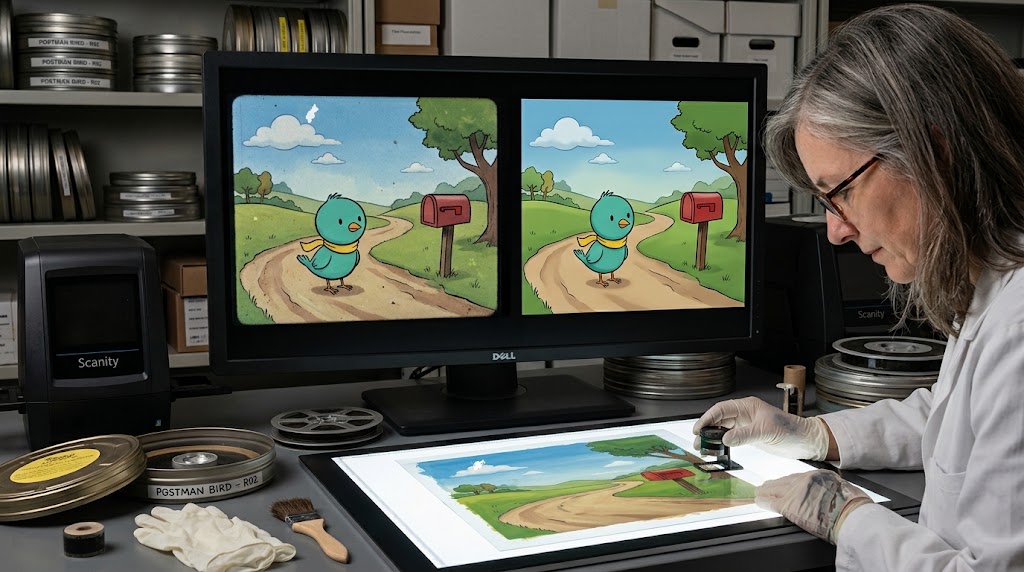
His films can be restored frame by frame.
Scratches can be removed.
Contrast can be corrected.
Sound can be cleaned.
A damaged negative can be reconstructed from surviving materials.
The performer sitting in the screening room receives no such restoration.
That is the bargain beneath much of Toon fame.
The work can become immortal.
The worker cannot.

Bosko does not ask for every forgotten cartoon to be revived.
He does not believe every old short deserves celebration.
He does not even believe everyone needs to remember him.
What he wants is smaller.
“I don’t begrudge Bugs the career,” he says. “I begrudge people acting like nothing came before it.”
Then he changes the subject.
Honey is about to appear onscreen.
The room darkens again.
A few residents settle into their chairs. Someone opens a piece of candy too loudly. One former performer whispers the setup of a joke before the soundtrack reaches it.
Bosko already knows every frame.
Honey walks into view.
The audience laughs.
Bosko waits until they are finished.
Then he smiles.
“People talk about being forgotten like it happens once,” he says.
“It happens every day.”
The film keeps running.
A moment later, the room laughs again.
Bosko looks toward the screen.
“They still laugh,” he says.
“That counts for something.”