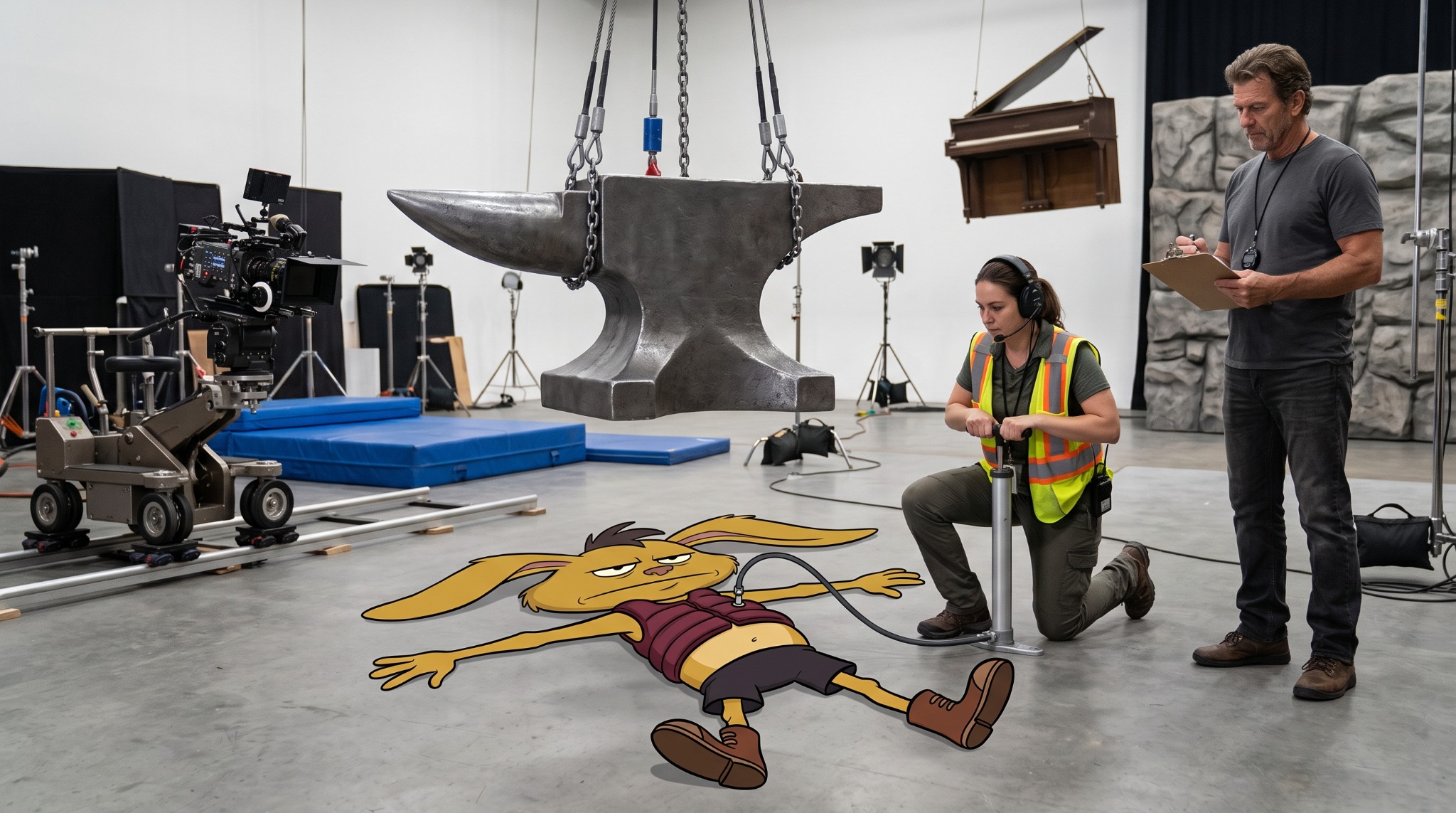
BURBANK — On a live-action set, dropping a 600-pound piano onto the lead actor would generally be considered a problem.
On a Toon set, it may be Take 4.
That distinction has supported an entire corner of the entertainment business for nearly a century: stunt performers who specialize in falls, explosions, flattenings, high-speed impacts, locomotive collisions and other acts that would end most careers — and most lives — after one attempt.
But as animated productions become more technically complex and studios demand more elaborate action, the people performing those stunts say the old assumption that “Toons bounce back” is increasingly being used to excuse working conditions that would never be accepted elsewhere in Hollywood.
“Survivable and safe are not the same thing,” says one veteran stunt coordinator who has worked on theatrical shorts, features and streaming series. “If somebody gets pancaked by a safe, yes, they’ll probably peel themselves off the pavement. That doesn’t mean you schedule another safe 90 seconds later.”
THE DOUBLE YOU NEVER NOTICED
For decades, studios rarely advertised the use of Toon stunt doubles.
Audiences generally assumed that the star they saw tumbling down a mountainside, being launched from a cannon or slammed through a brick wall was the star actually doing it.
Often, it wasn’t.
Stunt Toons are selected for unusual physical durability, body compatibility and, increasingly, the ability to reproduce a star’s silhouette under extreme deformation.
A good double must still look convincing when stretched six feet, compressed to the thickness of a dinner plate or briefly reduced to a blackened outline with blinking eyes.
That specialty has become harder as high-resolution production makes substitutions easier to detect.
“In the old days, you could put the right ears on somebody, match the gloves and send them over the cliff,” one coordinator says. “Now the audience can freeze every frame.”
Digital cleanup has solved part of that problem, allowing studios to adjust proportions or facial details after photography. But performers say that technology has also made it easier for productions to ask more of them.
A fall that once ended when the double hit the ground can now be extended into a bounce, a ricochet through three windows, an electrical transformation and a final impact with a passing bus.
The shoot still has to happen somewhere.
HOW MUCH RECOVERY IS ENOUGH?
The biggest issue is not whether a Toon can recover. It is how long recovery takes.
Different impacts require different resets.
But performers say that technology has also made it easier for productions to ask more of them.
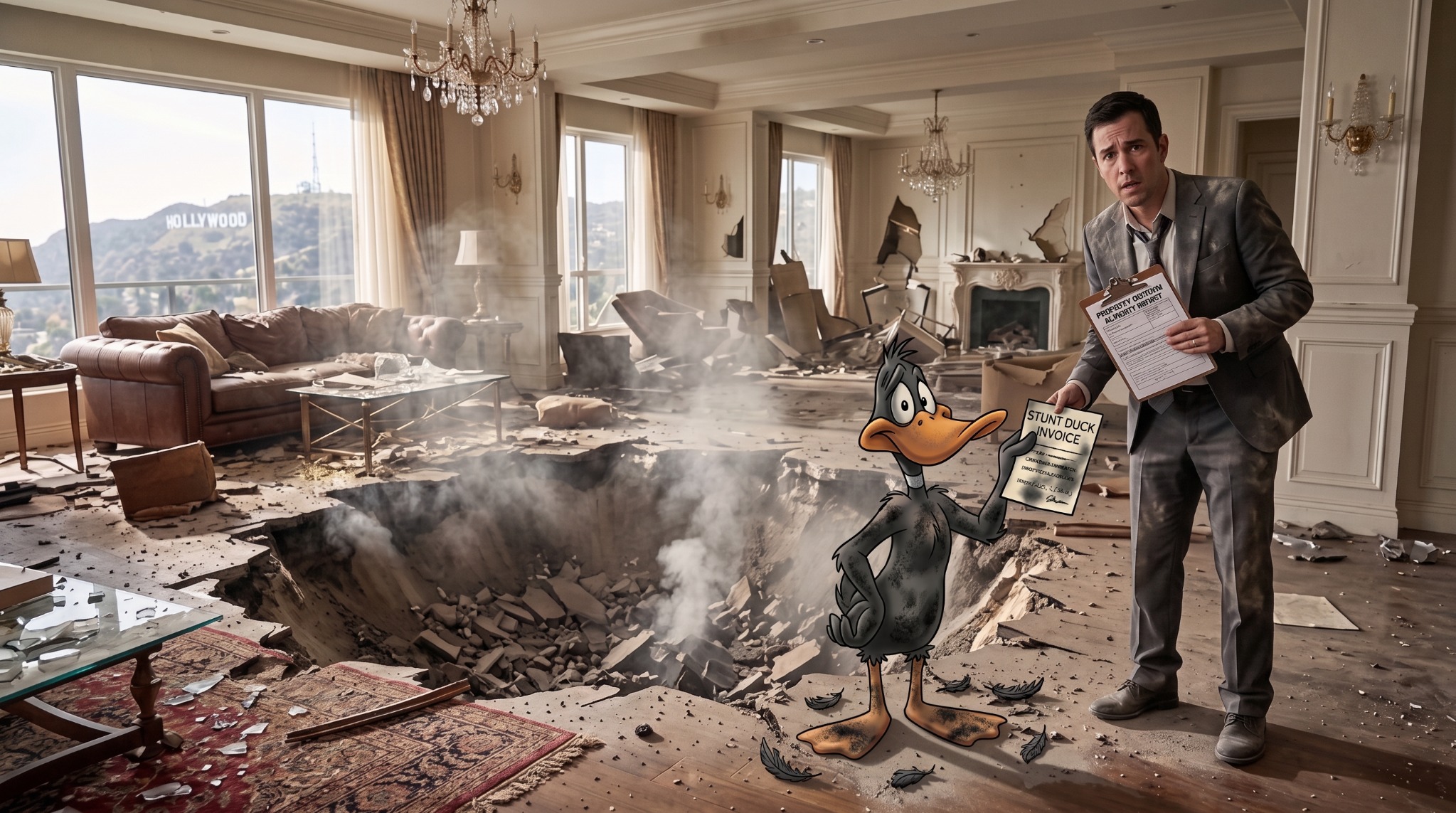
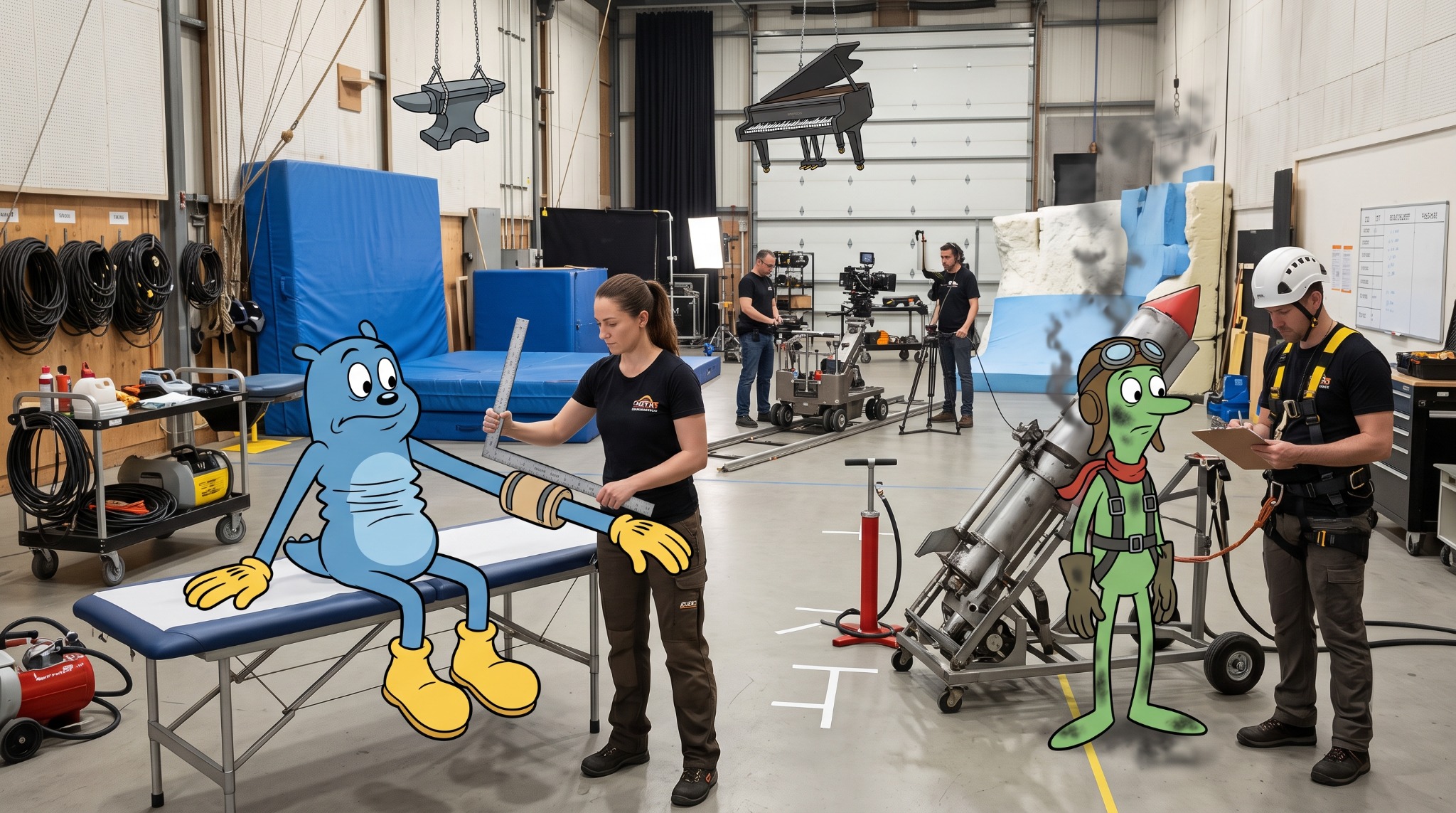
A simple wall collision may require only a few seconds of disorientation. Flattening can require manual reinflation. Severe scorching may leave performers smoking for several minutes. Explosive disassembly occasionally requires members of the crew to locate and reattach extremities before the next setup.
One production executive described the process as “part stunt department, part wardrobe, part emergency assembly.”
Stunt teams have increasingly begun building recovery periods into their schedules, particularly on productions requiring repeated takes.
Some contracts now distinguish between a standard stunt and what crews informally call a full reset — an impact after which the performer cannot simply stand up and return to first position.
That distinction matters financially.
A sequence involving six separate explosions may take only seconds on screen but occupy most of a shooting day once fire effects, debris removal, performer reassembly and continuity are taken into account.
Studios that fail to budget for those resets often discover that Toon durability does not necessarily make Toon action cheap.
THE STAR QUESTION
There is also disagreement over how much stunt work stars should perform themselves.
Some Toon performers are famously reluctant to surrender a fall.
Others have contracts limiting how often they can be crushed, exploded or fired from heavy artillery during principal photography.
The reasons are not purely physical.
Stunt coordinators say a star who insists on performing every impact can slow a production considerably. A professional stunt Toon may know exactly how to hit a wall, fold correctly and land face-first without damaging a key feature.
A principal performer may not.
“Everybody thinks getting hit by an anvil is getting hit by an anvil,” says one coordinator. “There’s technique.”
The most experienced stunt performers know where to stand beneath the drop, how to distribute the compression and how long to hold the flattened pose before recovery.
Improper technique can produce accordioning, uncontrolled springback or, in rare cases, permanent changes in height.
CREDIT WHERE CREDIT IS DUE
Recognition may be the larger fight.
Many Toon stunt performers have spent decades invisible in credits, particularly when studios want audiences to believe that marquee stars performed their own physical comedy.
That practice is slowly changing.
Newer productions are more likely to list stunt doubles alongside human stunt teams, and some performers have begun publicly identifying the scenes in which they appeared.
The push mirrors a broader conversation across Hollywood about stunt recognition — with one additional complication.
If the stunt performer is designed to be indistinguishable from the star, studios have historically argued that publicizing the substitution undermines the illusion.
Performers counter that the illusion is the work.
“You’re not supposed to notice me,” one veteran double says. “That doesn’t mean I wasn’t there.”
ANVILS ARE THE EASY PART
Ironically, coordinators say some of the industry’s most famous hazards are among the most predictable.
Anvils fall straight down. Pianos are heavy but stable. Dynamite has established blast patterns.
The dangerous work tends to involve combinations: moving vehicles, unstable terrain, mechanical launch systems or multiple effects timed together.
Rocket sequences remain particularly unpopular.
So do cliffs.
“The cliff is never just the cliff anymore,” says one production manager. “It’s the cliff, then the branch, then the river, then the waterfall, then the train.”
And because Toon performers have spent generations surviving those sequences, audiences expect escalation.
That expectation is unlikely to disappear.
The people doing the falling would simply like Hollywood to remember that getting back up is also part of the job.